


|
LINEAR PREAMPLIFIER & POWER AMPLIFIER AURA
Manufacturer: YUKIMU CORPORATION |

 |
 |
 |
|
Review
text by WOJCIECH PACUŁA |

|
No 265 June 1, 2026 |
THE TWO PRODUCTS THAT we would like to tell you in this review belong to the Linear Classics series and represent a step up from the highly acclaimed reincarnation of the VA40 integrated amplifier, as well as a return to designs known from the 1990s. The LCC 1 (Linear Classics Controller 1) linear preamplifier and the LCP 1 (Linear Classics Power 1) power amplifier were designed by Mr Isamu Nakazono, CEO of Yukimu Corporation. Their announcements and prototypes appeared in 2025, and they were launched in July 2025 (LCP 1) and early 2026 (LCC 1), respectively. The launch of the latter was delayed – it was due to take place in Japan in October, but was later postponed to December 2025. 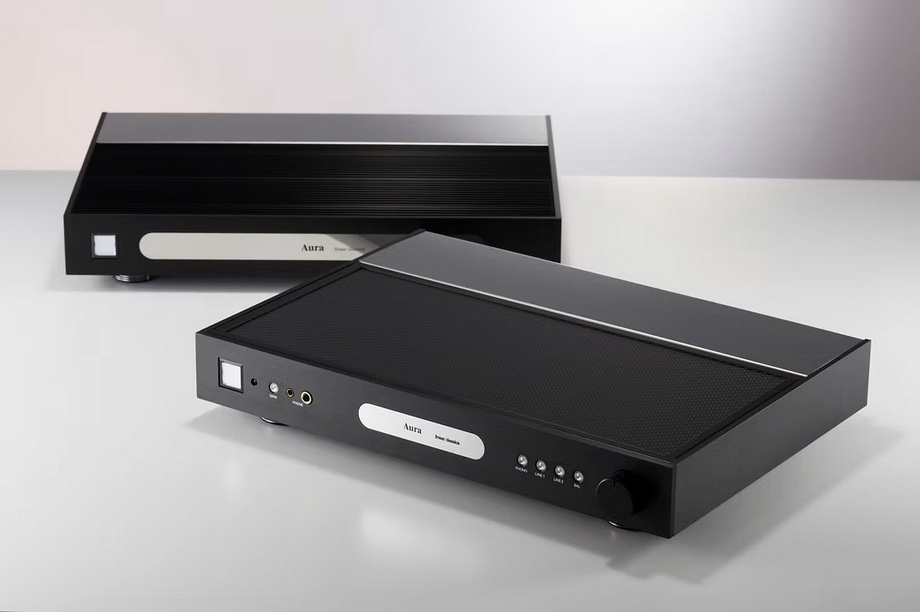
Aura products owe their unique appearance to the fact that Kenneth Grange, the renowned industrial designer who was then working with Bowers & Wilkins, the brand’s owner at the time, was hired to work on the designs years ago. The creator of the electronic circuitry is Michael Tu, the company’s founder. The current manufacturer also emphasises the importance of involving Japanese craftsmen in the production of their contemporary versions:
The amplifiers are meticulously designed and manufactured in Japan, with a focus on linear power supplies and analog technology. Furthermore, the precise metalwork from the globally renowned region of Tsubame-Sanjo in Niigata Prefecture is one of the key attractions of the Linear Classics. Combining pure analog design with a visually stunning aesthetic, these products exude a lasting sense of value that promises to endure well into the future.
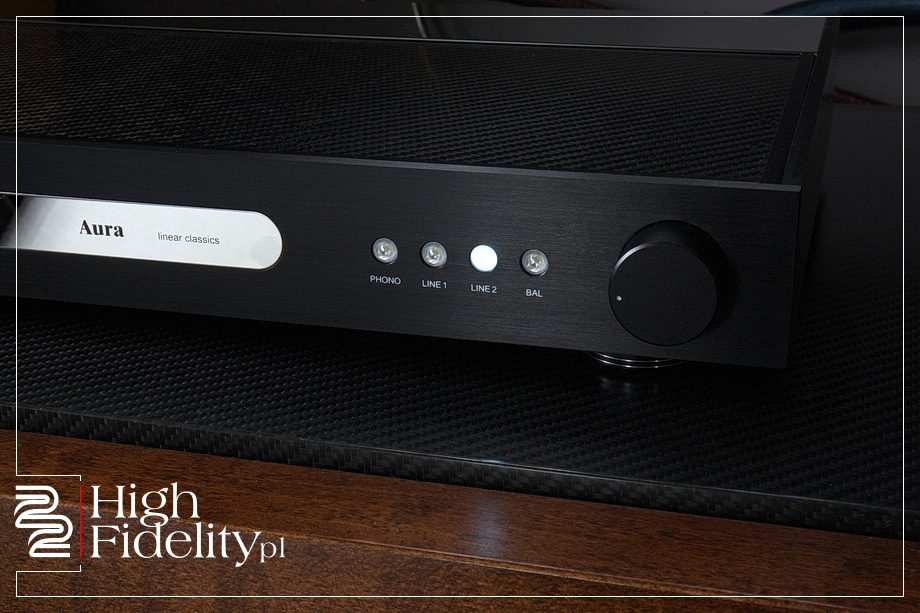
⸜ Linear Classic LCC 1, → www.YUKIMU-OFFICIALSITE.com, accessed: 20.04.2026. In our review of their first product in many years, the VA-40 Rebirth integrated amplifier, we asked the question: “What is it about this product that so many companies are interested in it?” The answer was both simple and unexpected for today’s hyper-capitalist market: sound quality. The audiophile market, which we are a part of, should be immune to market pressures; after all, it is a perfectionist market. So much for the theory. In practice, everything that happens in the mainstream reaches us, but in a diluted form and with a delay; more → HERE The return of the Aura in 2024 was therefore something of a ‘rebirth’ – not just of the model itself, as its name – Rebirth – suggested, but also of a certain trend within the audiophile realm itself, where sound quality and price are important again. Except that this time, it’s in a much better form than before. ▓ The LCC1 In the 1990s, Aura’s product range was quite extensive. It included integrated amplifiers, a linear preamplifier and two power amplifiers, a radio tuner and two CD players. Over time, the extensive range began to shrink, and by around 2010 it was considerably smaller. The brand’s early models in Japan were manufactured by the South Korean company April Music, known for products sold under the → STELLO brand. Some of its products were made in Korea, but a significant number were produced by Chinese companies. The current Aura product range is manufactured entirely in Japan. The front panel is made of extruded aluminium. The silver panel in the centre, curved on both sides, is set into a groove cut by laser to a depth of a few millimetres, creating a flat front surface. As we read, this silver stainless steel panel “is a symbol of the Aura brand” and, in the LCC 1 model, is located on the front and on the rear of the upper part of the cabinet. This panel is coated in chrome, and each unit achieves its lustre through hand polishing. The side panels are made of solid steel, and the top of carbon fibre weave. 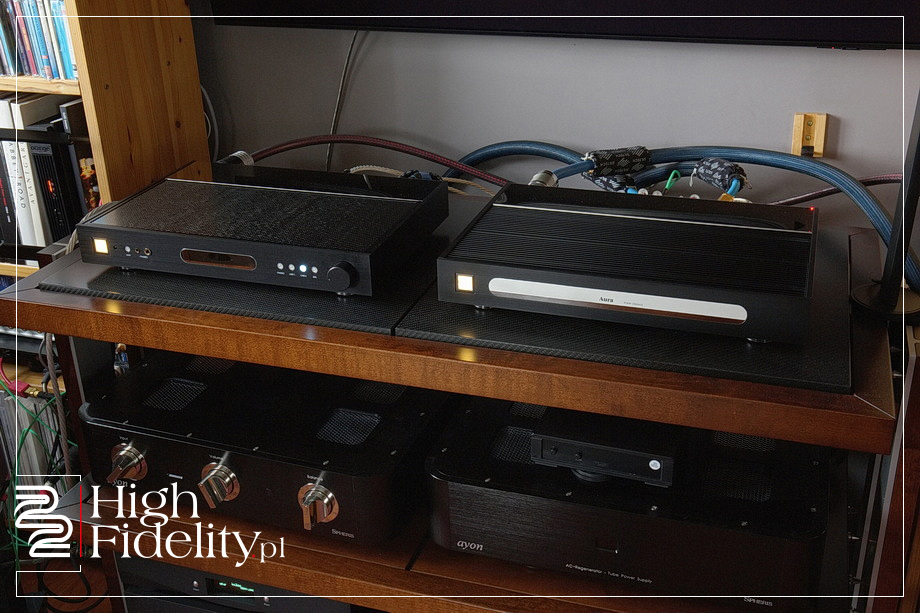
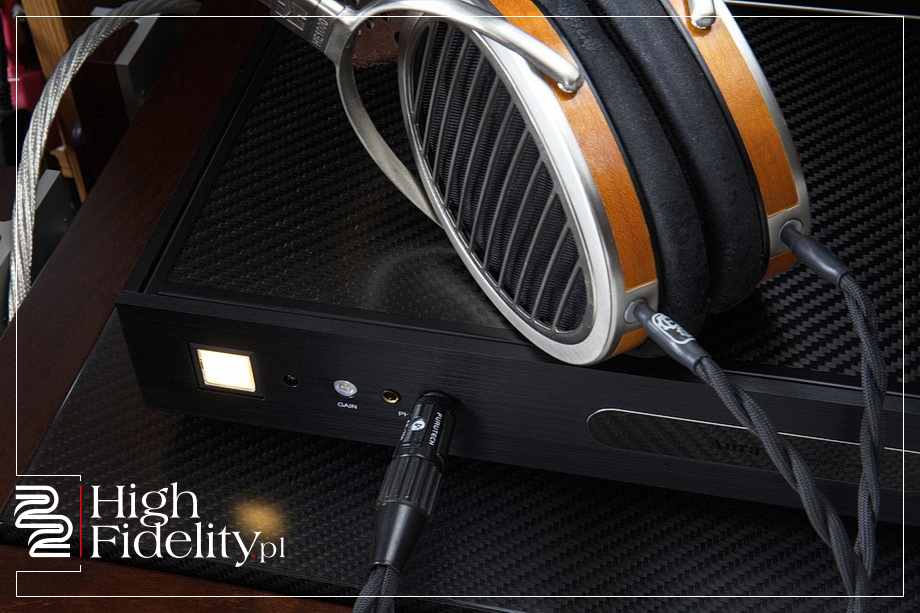
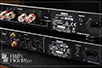
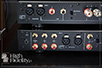
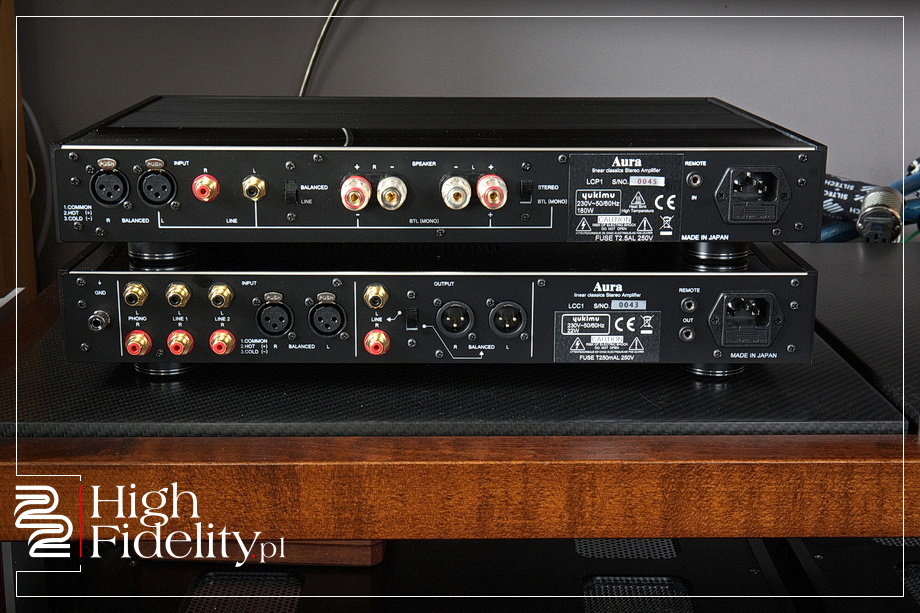
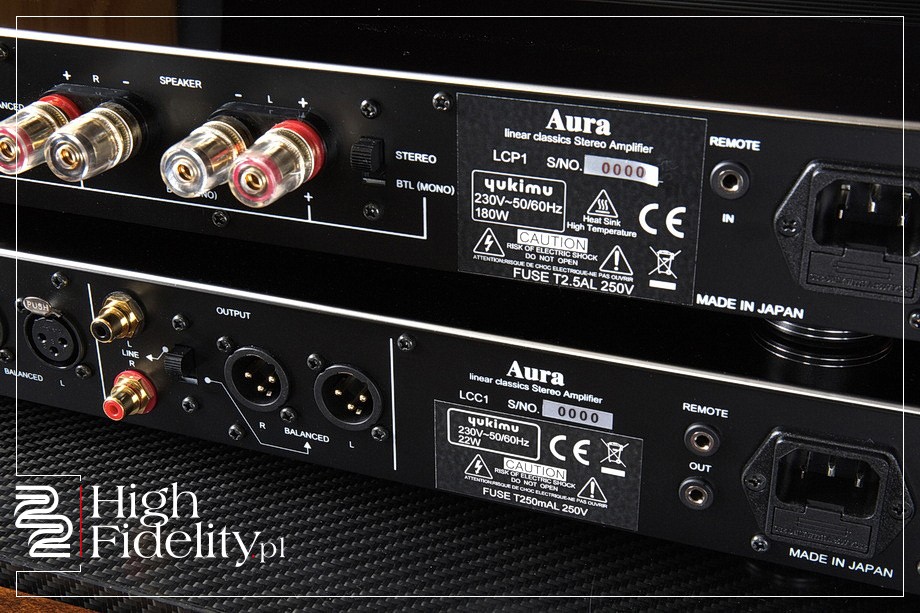
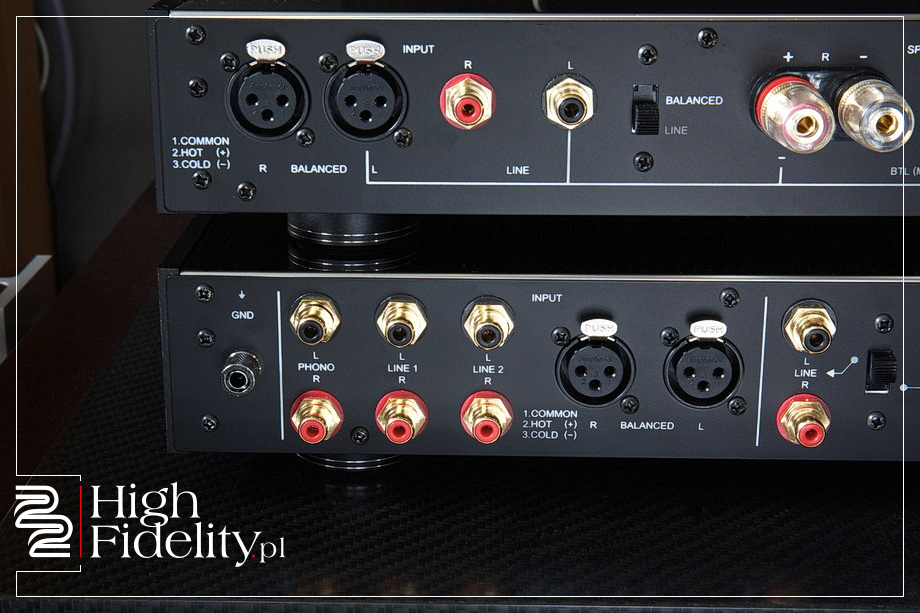
The LCC 1 preamplifier has the manufacturer’s classic dimensions, i.e., a front panel width of 430 mm and a height of just 55 mm. Both units under review are simply very low. The unit features a classic linear circuit design, with no digital control systems. It offers three line inputs, including two unbalanced RCA and one balanced XLR, as well as a phono input for an MM cartridge. The outputs are also available in two formats – RCA and XLR. The unit is, in fact, fully balanced. The LCC 1 is also equipped with a mini-jack socket for remotely switching on the LCP 1 amplifier. On the front panel, there is just one knob: volume control. It has a small dot to indicate the position, but no graduated ring. So, you can only ‘roughly’ gauge the position . The selected input is chosen by pressing the buttons with white backlighting. The power button is square, thus evoking the style of the 1970s and 1980s. It is also backlit. A separate button is provided for adjusting the headphone amplifier gain. The LCC 1 is, in fact, more than just a preamplifier. An integral part of it—perhaps even the most significant part—is the balanced headphone amplifier. The manufacturer emphasises its dual nature, referring to it in company promotional materials and describing it in the user manual as a “headphone amplifier / preamplifier”. The device offers two types of outputs: balanced 4.4 mm (Pentaconn) and unbalanced 6.35 mm TRS (‘jack’). The amplification section is discrete, based on large MOSFET transistors, and resembles a fairly large integrated amplifier. The manufacturer writes:
Yet its purpose goes far beyond simple pairing; the LCC-1 is built on an uncompromising design philosophy that prioritizes the essential core performance of a control amplifier handling delicate signals. Equipped with a full-balanced high-performance headphone amplifier section, the LCC-1 embodies Aura’s unwavering commitment to analog amplification. (Ibid.)
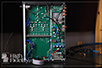
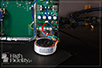
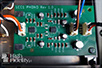
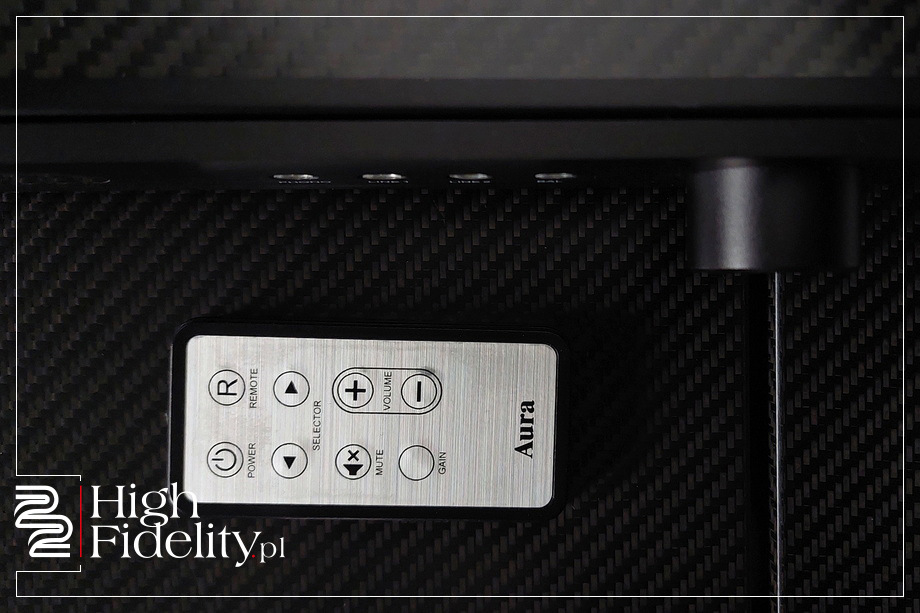
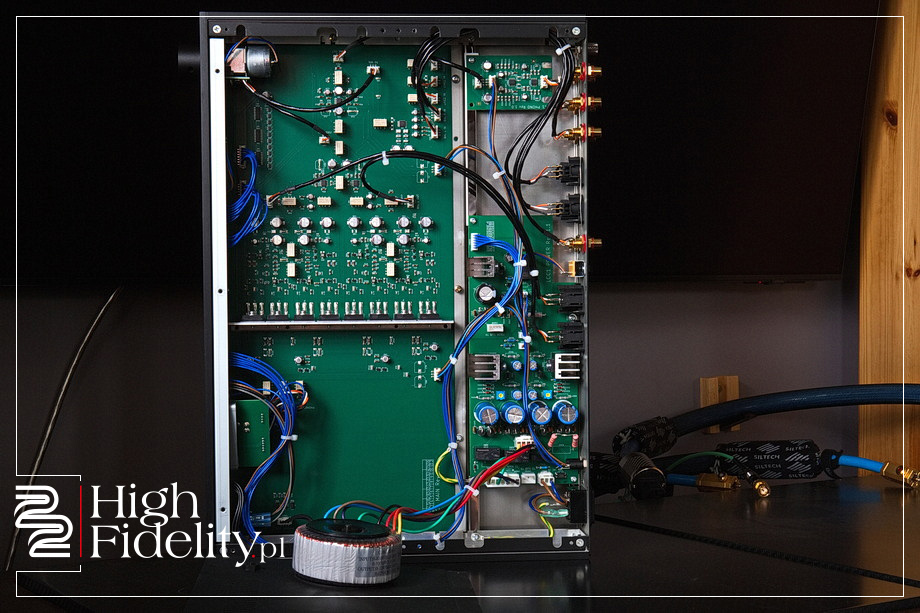
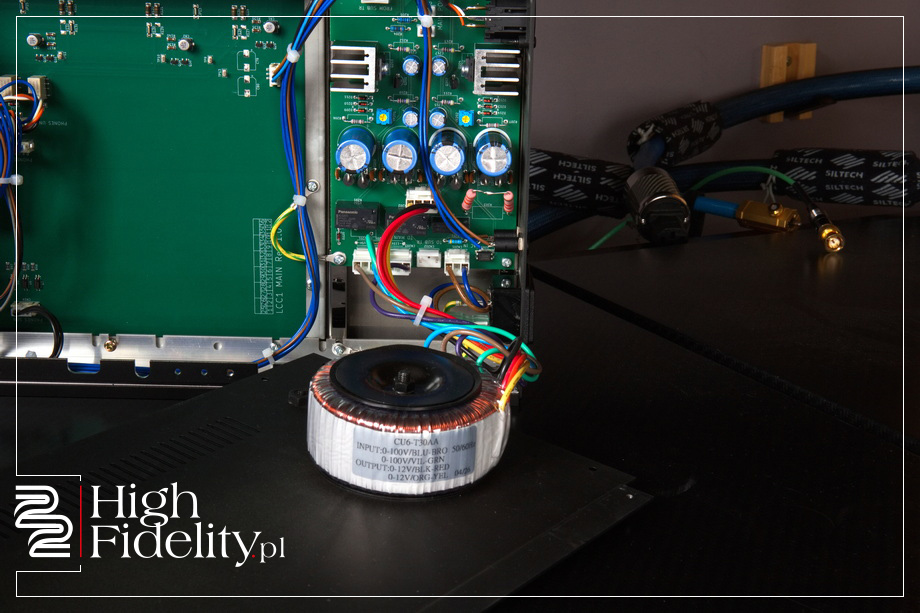
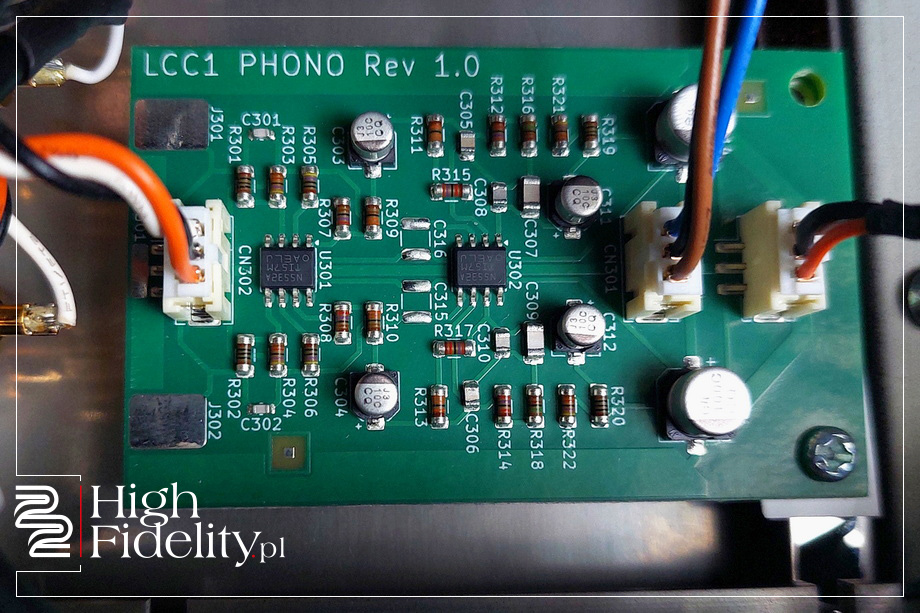
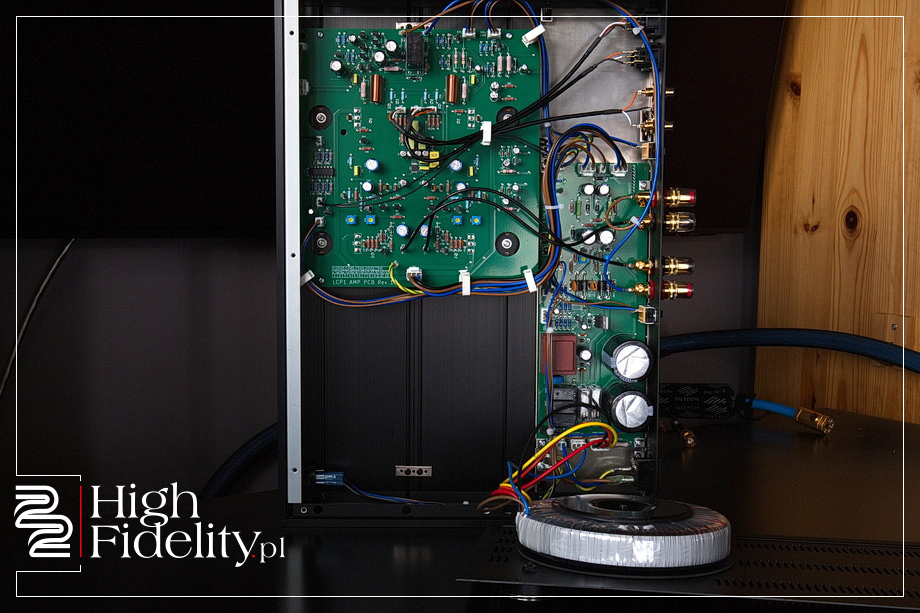
To fit all this into the limited space of the low-profile cabinet, ingenuity was required and, as we read, “the wisdom of eliminating superfluous elements and retaining only what is essential”. On this occasion, the manufacturer emphasises that minimalism, which is a fundamental concept for Aura, has a lot in common with the Japanese manufacturing culture, and that by setting limits on the size of the cabinet, “the product is imbued with deeper meaning and beauty”. The main board is mounted on the top panel, ‘on the back’, which is unusual. The manufacturer claims that this method, previously used in the VA 40 Rebirth model, was a key factor in achieving ‘open and natural sound’. On the underside of the LCC 1’s printed circuit board, a layer of copper foil has been placed to serve as magnetic shielding. The material used for the top cover, onto which this board is mounted, was selected from a range of options, such as ceramics, Corian and solid aluminium, based on “vibration damping and sound quality criteria”. Ultimately, carbon fibre was chosen. The phono preamplifier utilises the reliable classic N5532A integrated circuits. The entire board is surface-mounted. The line section features Burr Brown OPA 2134UA operational amplifiers. The circuitry includes high-quality components, such as Vishay metallised resistors and high-grade UKA, UUQ and UCQ capacitors. Input and output selection is handled by Panasonic relays, while volume control is managed via an Alps rotary potentiometer. The preamplifier stands on aluminium feet with rubber inserts, ensuring it does not slip (hurray!). The little remote control is membrane-based, compact and surprisingly easy to use. ▓ LCP 1 The LCP 1 power amplifier has a cabinet very similar to that of the LCC 1, though not identical. The dimensions are the same, but on the top panel, instead of a carbon fibre plate, there is a large heat sink to which the output transistors are bolted. The front panel is almost empty, apart from a long stainless steel plate and a square power switch. On the rear panel, there is a single pair of gold-plated sockets for the left and right channels, as well as two pairs of inputs: a balanced XLR and an unbalanced RCA. This is what the manufacturer writes about the transistor cooling system:
The VA 40 rebirth had gained attention for its unique heat management system, which used large heat sinks with MOSFETs mounted on top, and a reversed main circuit board supported by rods underneath. (…) Building on this, the LCP 1 further refines the cooling system to support large power devices capable of driving low-efficiency speakers.
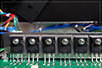
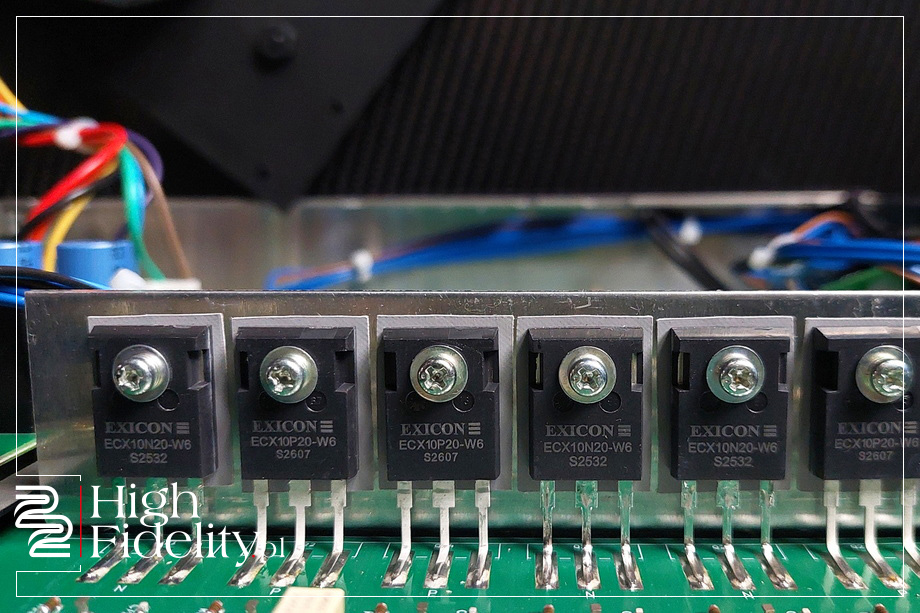
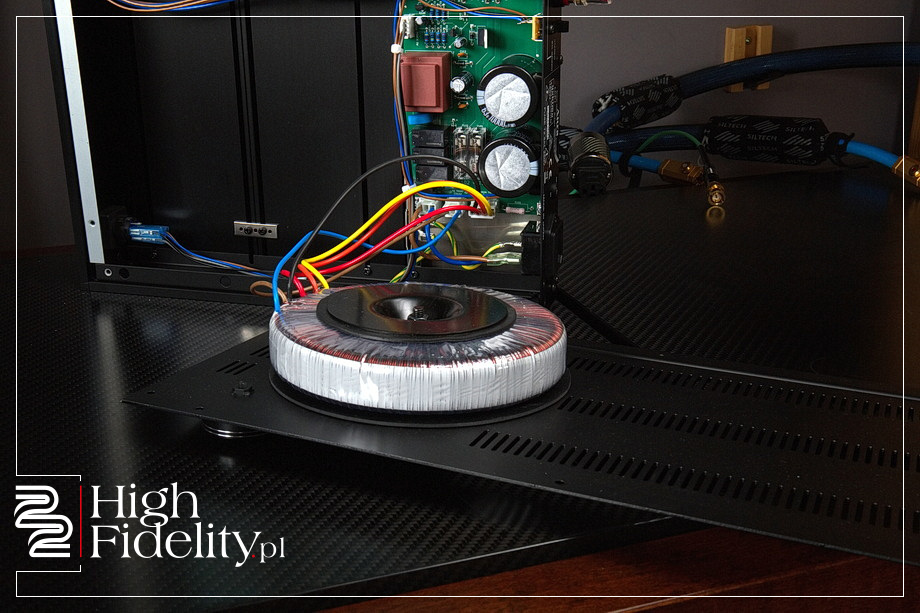
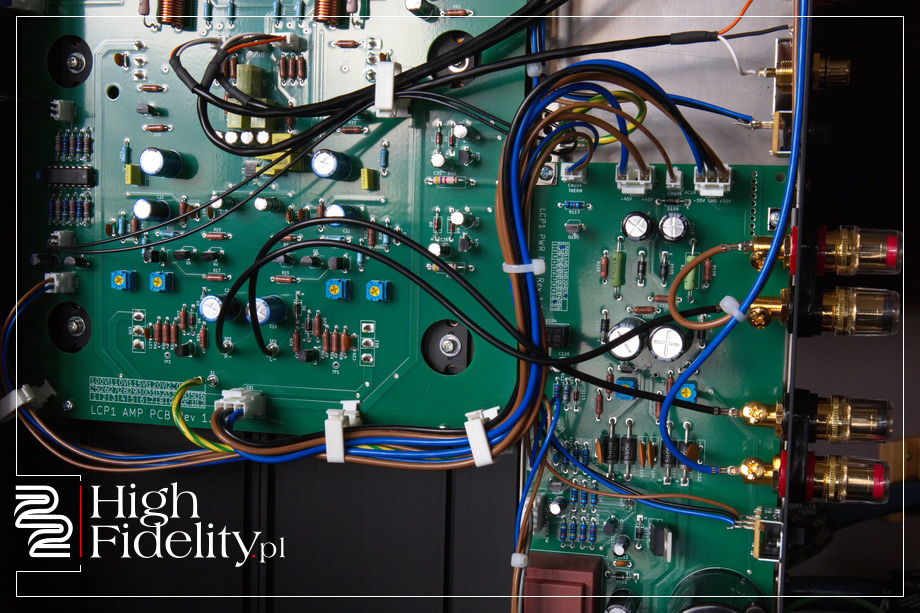
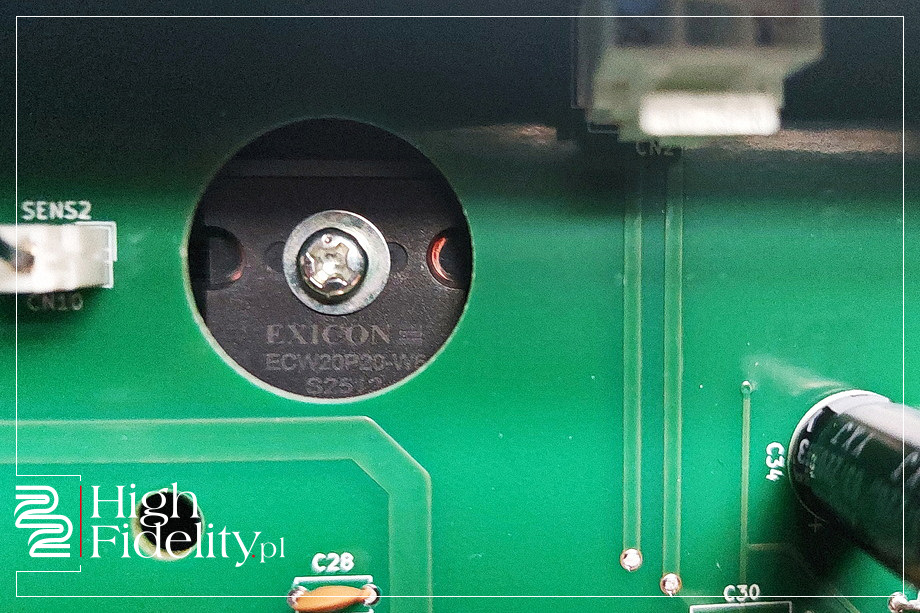
According to the manufacturer, by using more than half of the top plate’s surface as a heat sink, heat dissipation has been significantly improved. And that’s not all. Separation between the channels has also been improved by adding gaps between the heat sinks, which was intended to reduce crosstalk. This is important because each output stage uses a single pair of transistors, in class AB, in a push-pull configuration. Avoiding the use of multiple parallel transistors is a design strategy often employed in Japanese devices. The LCP 1 power amplifier features a single push-pull pair using MOSFETs manufactured by EXICON (the EXW20N20 + ECW20P20). As the gain path is very short, high-quality passive components were required. Here we find Vishay film resistors and Nichicon Muse capacitors. The custom, very flat, large power transformer also looks excellent. 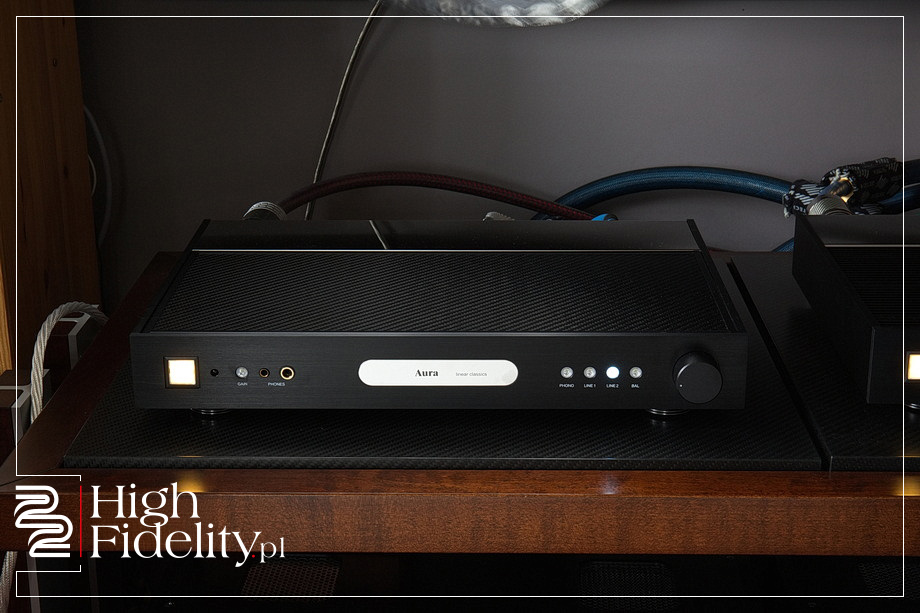
The LCP 1 amplifier delivers 75 watts into an 8 Ω load, which is quite a lot. However, if you need more power, you can bridge it (BTL = Bridge-Tied Load). The stereo amplifier then becomes a monophonic amplifier. Our system will therefore require two of the same units. The power available to us will be 150 W per channel (8 Ω). Switching between stereo and BTL is done using a switch on the rear panel. Both devices look fantastic and I really enjoyed unpacking and setting them up. They’re so cool that it would be a shame to hide them away. If at all possible, let’s leave them side by side on the top shelf of the rack. ▓ THE LISTENING SESSION <THE WAY WE LISTENED • The Aura preamplifier and power amplifier were placed on the top shelf of the Finite Elemente Pagode Edition Mk II rack, on their own feet, side by side. They were compared to the reference system consisting of the Ayon Audio Spheris Evo preamplifier and the Soulution 710 power amplifier. The amplifier drove the Harbeth M40.1 speakers via the Crystal Cable Da Vinci cable. 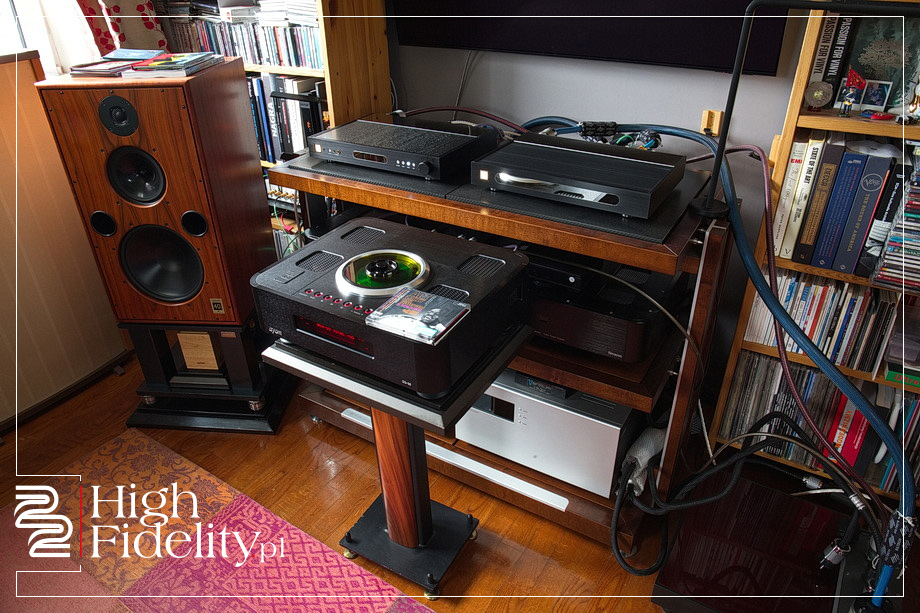
Signal between the components under review was transmitted via the Crystal Cable Absolute Dream unbalanced cable, while power was supplied via the Acrolink Mexcel 7N-PC8500 and Harmonix X-DC350M2R Improved-Version cables, respectively. The main sources used were the Ayon Audio HF-35 HF Edition SACD player, the Sforzato DSP-05EX file player with the PMC-05EX clock, and the Rega P8 turntable with the Shelter 201 cartridge. 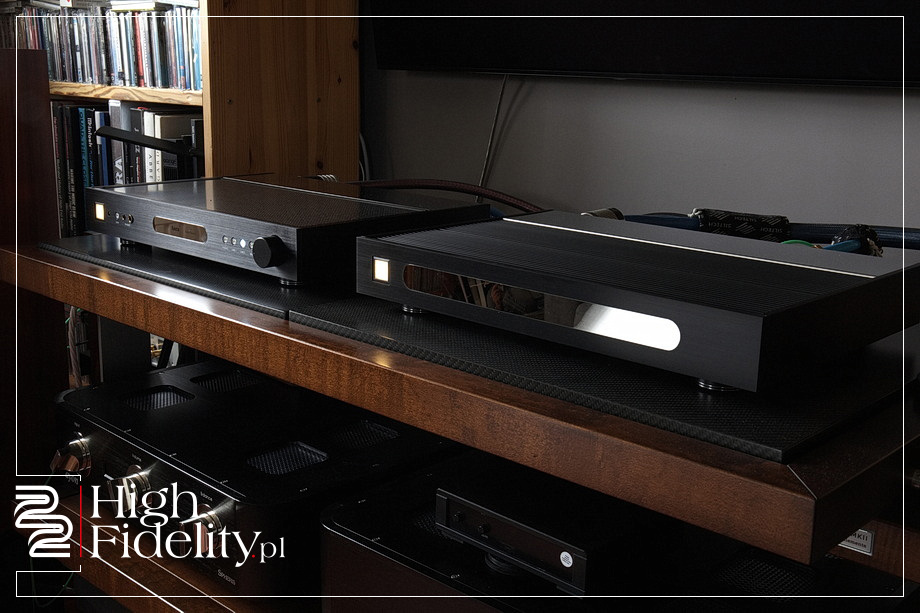
I used the following headphones to test the headphone amplifier: • HIFIMAN HE1000 v2 – magnetostatic drivers, impedance: 35 Ω, sensitivity: 90 dB/V SPL; review → HERE, |
» ALBUMS USED IN THE TEST ⸜ a selection
• CHET BAKER, The Making of Chet Baker Sings, Jazz Images Records 83310, CD ⸜ 1956/2021. WHILE LISTENING TO THE Aura VA-40 Rebirth AMPLIFIER, I couldn’t help but admire its designers’ skill. They’ve managed to pack a device which sounds captivating and beautiful in a tiny cabinet. It wasn’t just a matter of the simple combination of the device’s size and sound quality. It was something deeper and far more significant. It was about the beautiful way in which sound can be produced by a small, affordable and attractive device. 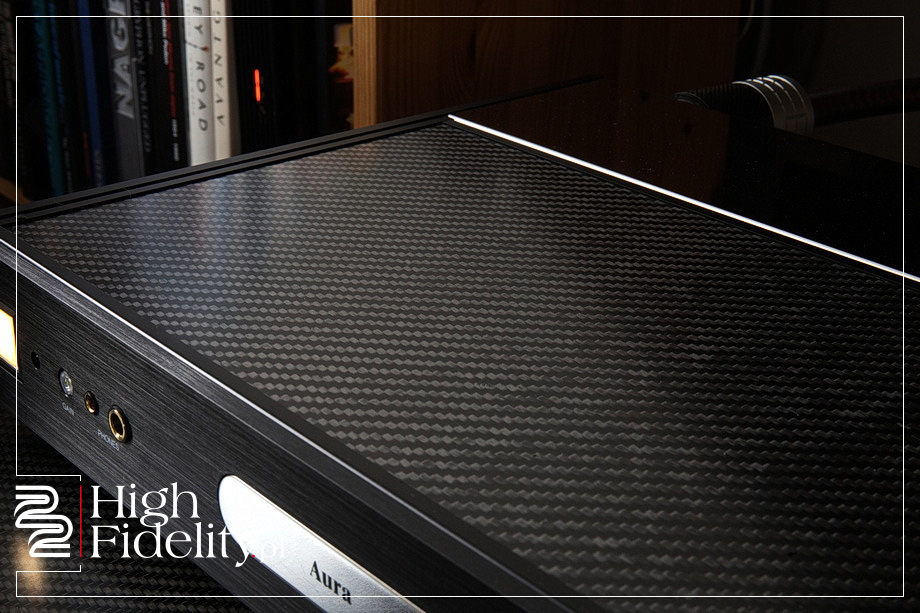
So, I must disappoint those who expect that the CLL1 and CLP1 split system will deliver the same thing, only ‘better’ and ‘more’. It is not the case that by splitting the components into two cabinets, duplicating the power supply and increasing the power output, we get scaled-up benefits. The Aura preamplifier and power amplifier are something different than a ‘new VA 40’. On the one hand, this marks a departure from the warm and pleasant sound of the VA 40, and on the other, it offers something significantly better. This system from Japan renders sound with exceptional detail. That’s number one, two and three. It differentiates tones, dynamics, scale and, importantly, space along with perspective. That’s why CHET BAKER singing ˻ 10 ˺ My Funny Valentine from the album Chet Baker Sings not only had beautiful, intimate, warm and silky vocals, but also varying in intensity and distance from the microphone. It was alive and changed throughout the song, rather than simply ‘warm’. It was there that I heard something for which many of you will love this little system: remarkable depth of the soundstage. Something like this shouldn’t happen; this is what I get from my split system. Baker was in the foreground, and each subsequent musician, along with the drums, was placed further and further back, yet remained clear and was still part of the performance. The instruments themselves were also large and substantial. It wasn’t quite as precise a reproduction as from the reference system or other expensive, high-quality amplifiers, yet the quality of what I heard was exceptional. The same applies to dynamics. The first few moments with the system reveal its liveliness and a rather ‘stiff’, strong attack. When we listen to it for a longer period, we realise that this is not harshness, but precision, and that the attack is followed by what builds the sound: multi-layered, deep imaging with shapes and dynamics. That is why on the opening track of the albumFirst Flight To Tokyo: The Lost 1961 Recordings by ART BLAKEY AND THE JAZZ MESSENGERS, the long drums solo at the beginning of ˻ 1 ˺ Now’s The Time surprised me with its intensity, or rather scared me (and I was listening really loudly). The point is that the beginning of this track has been edited so that it starts with a powerful strike on the kettle and cymbals. Quite simply, the beginning has been cut off, going straight to high-volume sound (high SPL). Because the recording has a wide dynamic range, and the amplifier under review demonstrates this perfectly, the strike was sudden and powerful – very, very sudden and very powerful. The amplifier from Japan delivered this – as you might expect – in a fast and aggressive manner. It was a bang, a sudden ‘boom!’, followed immediately by dense sound. So, after my initial impression that I was getting somewhat technical sound leaning towards precision, it turned out that these were simply elements that complemented what I already had with the VA 40, namely fullness and density. And along with that, I also gained more substantial low-end bass response and better control over it. I’m not sure if I remember correctly, but with the integrated amplifier all recordings were presented in a somewhat uniform manner – wonderful, but similar. In this respect, the split system is completely different. So, what we get is powerful, large and intense sound. It is precise, yet with great tonal depth and an incredibly dense, deep soundstage. All of this is perfectly differentiated – I’ll say it again: perfectly. It is also dense and low, too. In the test, the system reproduces high frequencies accurately. However, it shows a certain restraint here; it is not overly ‘precise’ in defining the onset of the attack. So, we have powerful high frequencies, though without being overwhelmed by the amount of information. It delivers powerful, expansive and intense sound – precise, yet very deep. The lower end of the frequency range is equally active. This is something that should appeal to anyone whose systems are notoriously ‘underweight’ or lacking in bass. The bass lines in tracks such as ˻ 1 ˺ Autumn Leaves from CANNONBALL ADDERLEY’s album Somethin' Else, the dense distorted bass line on ˻ 5 ˺ Wandering Star by PORTISHEAD or even THE MILLS BROTHERS vocals from the album Famous Barber Shop Ballads. Volume One, all of it was especially large and had “weight”, or “gravity”. This particular characteristic of the Japanese system had already emerged earlier with Blakey, when at 0:20 seconds of the first track something suddenly hits hard in the low end, and a moment later it repeats. It’s some part of the drum sound that was probably inaudible in the original, but which was cleaned up after the sound was boosted during remastering. It is similar with the low ‘pops’ in the drummer’s voice as he announces the next track, ˻ 2 ˺ Moanin’. 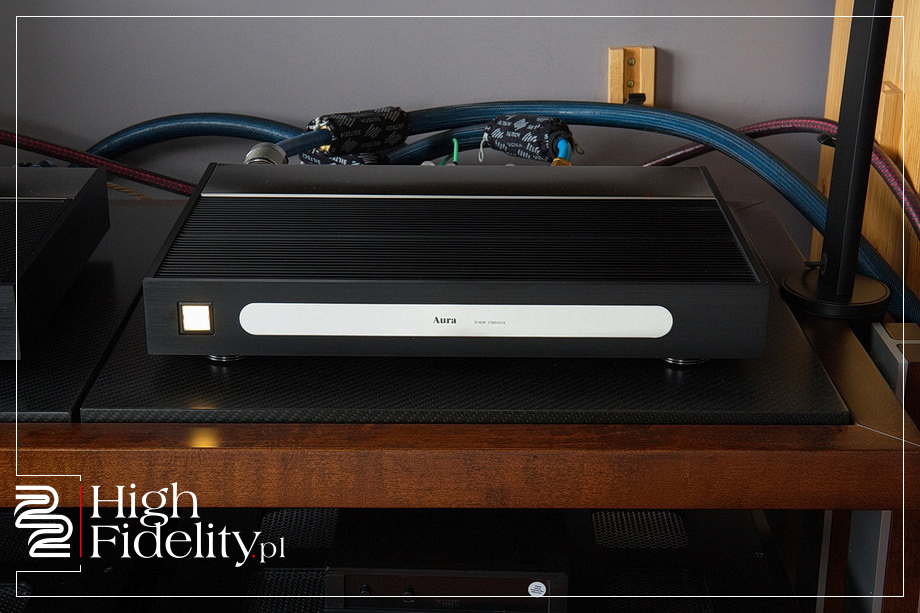
As it happens, the system under review is, on the one hand, incredibly warm, like a tube amplifier, and on the other precise, like a transistor amplifier. And that’s fine; it’s not uncommon, in fact it happens quite often. But let’s listen to I (Who Have Nothing by ROBERTA FLACK and DONNY HATHAWAY from their perfect album Roberta Flack & Donny Hathaway, and we hear a very precise depiction of the scene, just as it was imagined in the 1970s, but also warm vocals, mixed quite far back yet still clear, and on top of that the low, powerful pulse of the bass drum, all at once together with soft, warm bass in the left channel. HEADPHONES • The CLL1 preamplifier is described in press materials as a preamplifier/headphone amplifier – we already know that. Now I also know that this description is by no means an exaggeration. The headphone section in this device is just as high-end as the linear section, as they ultimately share most of the same components, such as the power supply, input circuitry and volume control. This results in warm yet precise sound. Even with headphones as transparent as the Hifiman HE-1000 v2, it was an extremely enjoyable and satisfying experience. The lowest bass won’t be quite as ‘gut-wrenching’ and tangible as when listening through speakers. On the other hand, it won’t be thin either. This is obviously down to the nature of listening through speakers, but also to the character of the amplifier itself. It is incredibly open in the midrange. The processed vocals, backed by the powerful synth sound in the background, which we hear in Walk Out Music by JAMES BLAKE on his album Trying Times, were clear and intense. They were also perfectly balanced. And that’s probably what sticks with you after using this device – the balance between all the elements. If the Hifiman headphones feel a bit too much for you, try the Final Audio DX6000, and you’ll get exactly the same thing, but with a warmer and darker tone. And even the heavy compression on the single Tunguska by ASHBURY HEIGHTS, with that incredible vocal right in the centre, perfectly on axis, won’t sound too bright. And if it does, then – I’ll say it again – try the Final Audio headphones. ▒ Conclusions THE SYSTEM UNDER REVIEW is one of several, that I could live with, should I suddenly have to swap my elaborate system for something smaller. I felt the same way about the VA 40 Rebirth. However, the preamplifier with the power amplifier is something more – it reproduces a wider range of sounds, plays with greater power, more precisely and with an even richer tonal palette. The Japanese system handles the bass brilliantly, as it controls it while also filling it out and saturating it. The same applies to the upper end of the frequency range. The midrange is warm and dense, but this stems from the density of the powerful bass rather than any colouration. Together, this produces intense, electrifying sound with full breadth and dynamics. The sound is rich and precise. Above all, however, it is fascinating. 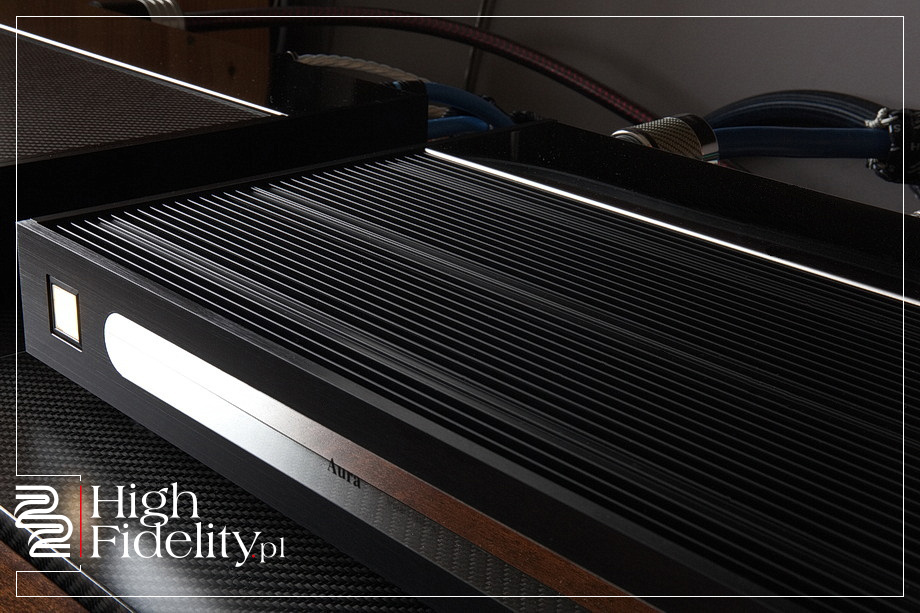
I think that’s the most important thing about it. When listening to great, warm-sounding amplifiers – be it the Aura, which has been mentioned many times, or the Aurorasound HFSA-02, Soulnote A-2 ver. 2 or Audio Research i/70 – we lose ourselves in their sound, taking pleasure in each successive record. It’s brilliant. With the LCC 1 & LCP 1 system, we get the same plus something extra: satisfaction of curiosity. Alongside the emotion, we also get information. Lots of information. ‖ WP » The text contains an affiliate link to the CD JAPAN online store ▒ Technical specifications (according to the manufacturer)
‖ The LCC 1 
THIS TEST HAS BEEN DESIGNED ACCORDING TO THE GUIDELINES adopted by the Association of International Audiophile Publications, an international audio press association concerned with ethical and professional standards in our industry, of which HIGH FIDELITY is a founding member. More about the association and its constituent titles → HERE. |
 |

|
Reference system 2026 |
|
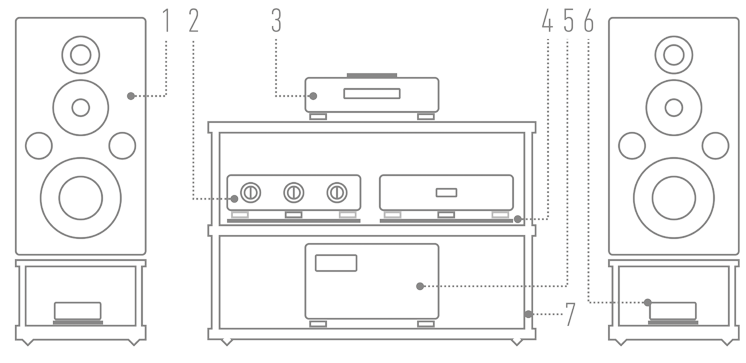 1) Loudspeakers: HARBETH M40.1 |REVIEW| 2) Line preamplifier: AYON AUDIO Spheris III Linestage |REVIEW| 3) Super Audio CD Player: AYON AUDIO CD-35 HF Edition No. 01/50 |REVIEW| 4) Stands (loudspeakers): ACOUSTIC REVIVE (custom) |ABOUT| 5) Power amplifier: SOULUTION 710 6) Loudspeaker filter: SPEC REAL-SOUND PROCESSOR RSP-AZ9EX (prototype) |REVIEW| 7) Hi-Fi rack: Hi-Fi rack: finite elemente MASTER REFERENCE PAGODE EDITION Mk II, more → HERE |
|

|
Cables Analog interconnect SACD Player - Line preamplifier: SILTECH Triple Crown (1 m) |ABOUT|» ANALOG INTERCONNECT Line preamplifier → Power amplifier: Siltech ROYAL SINLGE CROWN RCA; review → HERE Speaker cable: SILTECH Triple Crown (2.5 m) |ABOUT| |

|
AC Power Power cable | Mains Power Distribution Block - SACD Player: SILTECH Triple CrownPower (2 m) |ARTICLE| » POWER CABLE Mains Power Distribution Block → Line preamplifier: Acoustic Revive ABSOLUTE-POWER CORD, review → HERE » POWER CABLE Mains Power Distribution Block → Power amplifier: Acoustic Revive ABSOLUTE-POWER CORD, review → HERE Power cable | Power Receptacle - Mains Power Distribution Block: ACROLINK Mexcel 7N-PC9500 (2 m) |ARTICLE| Power Receptacle: Acoustic Revive RTP-4eu ULTIMATE |REVIEW| » ANTI-VIBRATION PLATFORM under Acoustic Revive RTP-4eu ULTIMATE: Graphite Audio CLASSIC 100 ULTRA, review → HERE Power Supply Conditioner: Acoustic Revive RPC-1 |REVIEW| Power Supply Conditioner: Acoustic Revive RAS-14 Triple-C |REVIEW| Passive filter EMI/RFI: VERICTUM Block |REVIEW| |

|
Anti-vibration Speaker stands: ACOUSTIC REVIVE (custom)Hi-Fi rack: finite elemente MASTER REFERENCE PAGODE EDITION Mk II, more → HERE Anti-vibration platforms: ACOUSTIC REVIVE RAF-48H |ARTICLE| » ANTI-VIBRATIONAL FEET: |

|
Analogue Phono preamplifier: Phono cartridges:
Clamp: PATHE WINGS Titanium PW-Ti 770 | Limited Edition Record mats:
|

|
Headphones » HEADPHONE AMPLIFIER: Leben CS-600X, review → HEREHeadphones: Headphone Cables: Forza AudioWorks NOIR HYBRID HPC |