

|
INTEGRATED AMPLIFIER AURORASOUND
Manufacturer: AURORA SOUND Inc. |

 |
 |
 |
|
Review
text by WOJCIECH PACUŁA |

|
No 263 April 1, 2026 |
The HFSA-02 is the second integrated amplifier in Aurorasound’s history. As a reminder, the first was the excellent, compact HFSA-01 amplifier; you can find the review → HERE. However, while the design of the “01” was—to some extent—inspired by the Leben CS-300, the “02” draws on a classic look for this type of product. That is, with a low-profile chassis, tubes in the front, and transformers in the back. 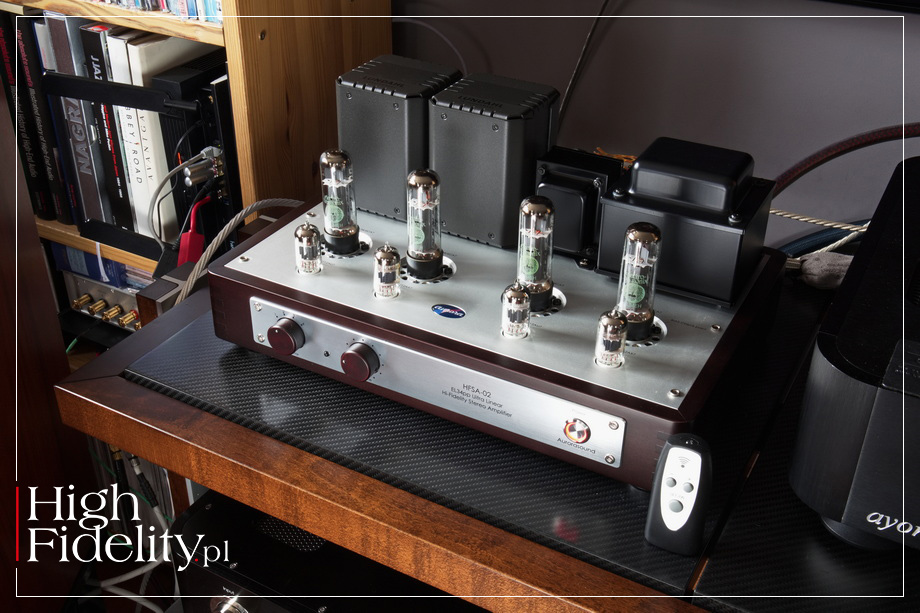
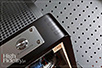
The manufacturer refers to this device as a “pre-main amplifier,” emphasizing the equal importance of the preamp and power amp sections. However, there is something more to it. Unusually for Japanese manufacturers of tube equipment, the amplifier under review can be equipped with three different input boards and can even be ordered as a power amplifier. ▓ HFSA-02 THE “HFSA” IN THE AMPLIFIER’S NAME stands for High Fidelity Stereo Amplifier, and the “02” indicates that this is the second such product in the company's lineup. The HFSA-02 is an integrated tube amplifier with a solid-state power supply. Its rated output power is 31 W per channel (into an 8 Ω load), and is derived from two pairs of EL34 (or American 6CA7) power tubes operating in a push-pull configuration in AB Class. A distinctive feature of this amplifier is its chassis. Its frame is made of 22 mm thick maple wood, with individual components fastened in the traditional furniture-making style. Stained a dark color, it looks truly attractive. It is closed at the top and bottom with 4 mm-thick aluminum sheets, and the whole unit stands on four metal feet glued to the bottom. As stated, “the heavy transformer and sensitive vacuum tubes are supported by this enclosure, which allows for the reproduction of rich midrange and low frequencies, as well as delicate high frequencies.” FEATURES • As we read, the input stage features an “orthodox preamplifier” built using vacuum tubes—specifically, ECC83 and ECC82 double triodes. And further on:
It is carefully designed and manufactured by hand to not only meet the needs of the modern digital, high-resolution era, but also provide sufficient functionality and performance for analog playback. It can be used for many years to come as the Tube Amplifier that will remain unchanged for decades.
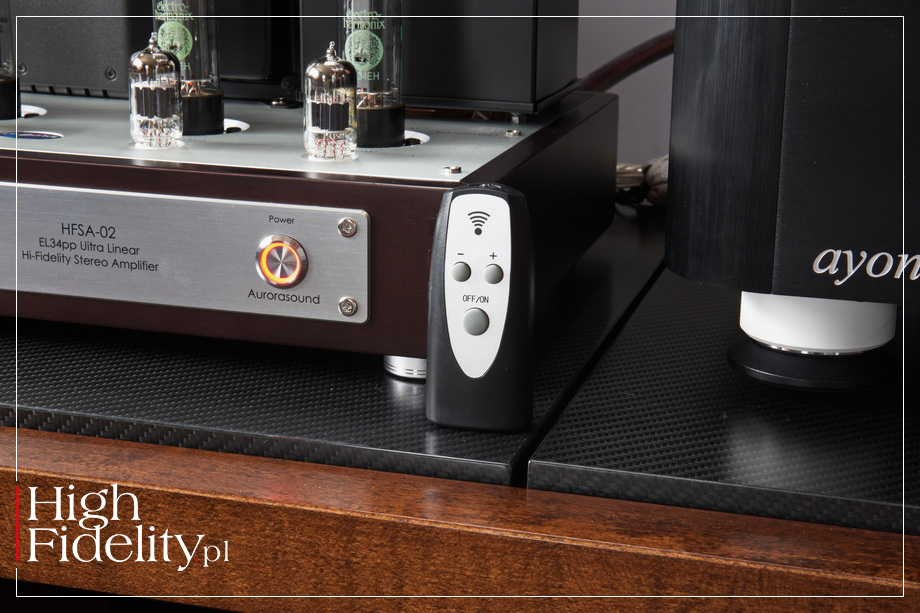
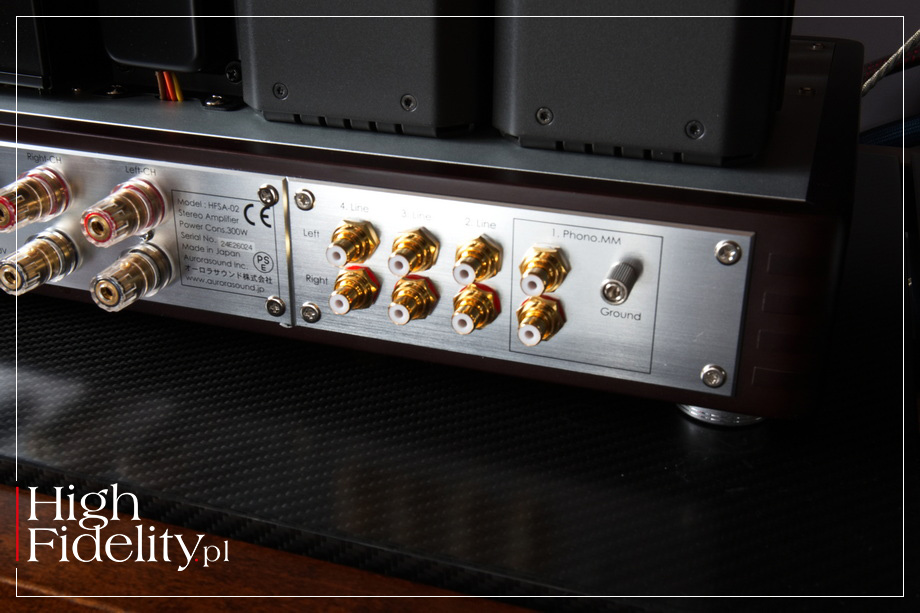
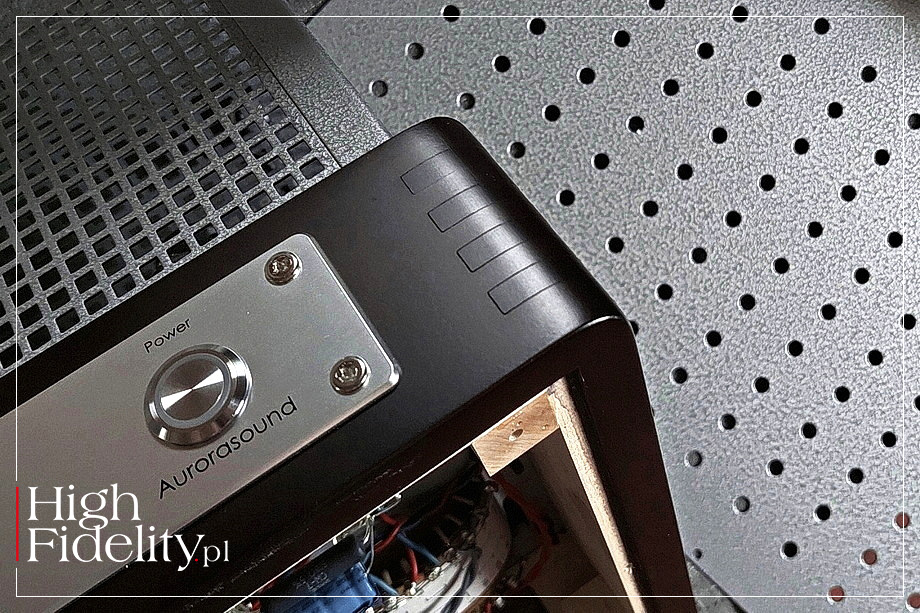
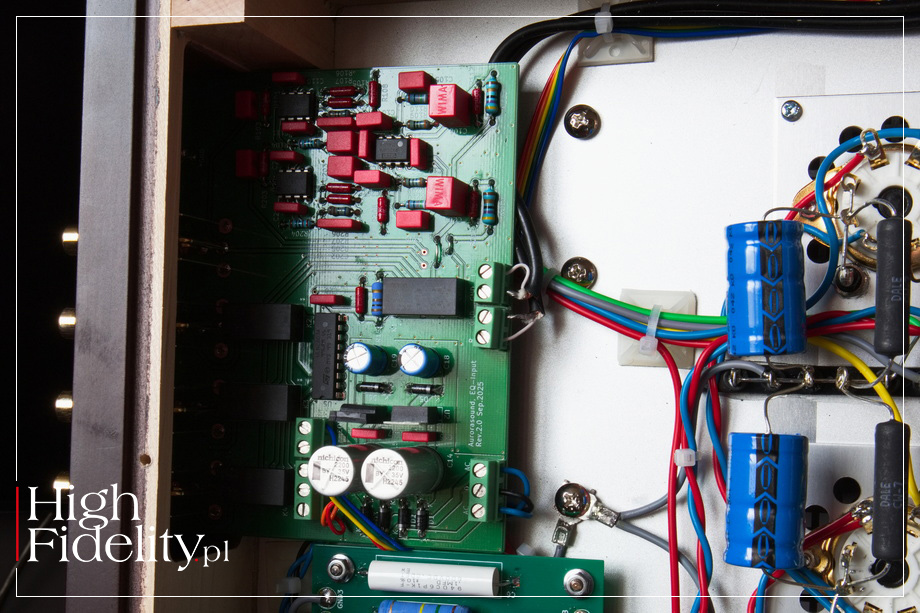
⸜ HFSA-02. Stereo Pre-Main Amplifier, → www.AURORASOUND.jp, accessed: 25.02. 2026. This section is one of the coolest innovations in this segment—that is, of classic tube amplifiers. I saw this recently in the Audio Research I/70 amplifier, so it’s probably a sign of the times. In its basic version, it features four RCA line inputs, an input selector, and a volume control. There are three other options also available: 1) balanced XLR input + 3 x RCA line inputs, surcharge: 2,990 PLN, A replacement rear panel is available for each version, so you should think ahead and select it in advance. The phono and XLR inputs feature solid-state circuits. And Mr. Karaki has extensive experience with this type of amplification—after all, nearly all the other devices in his lineup are solid-state products. On the front panel, you’ll find only two knobs and a power switch. The knobs let you select the active input and adjust the volume. The power switch, on the other hand, is used to turn the power on and off. It is a solid module, used by this manufacturer in other products. It has a red backlit ring that lights up when the button is pressed. The knobs, in turn, are made of wood since, as we mentioned, the amplifier’s chassis is made of wood. The volume can also be controlled using a remote. It isn’t particularly attractive—it’s a plastic unit—but it works. This option costs as much as 2,490 PLN. However, it’s important to remember that this isn’t just the remote itself, but the entire control system and potentiometer with a motor. 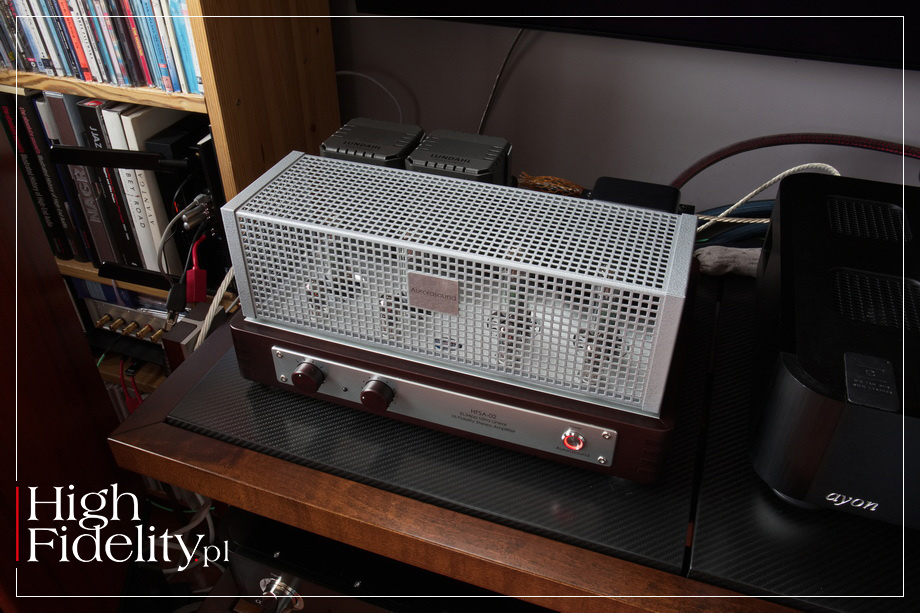
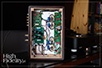
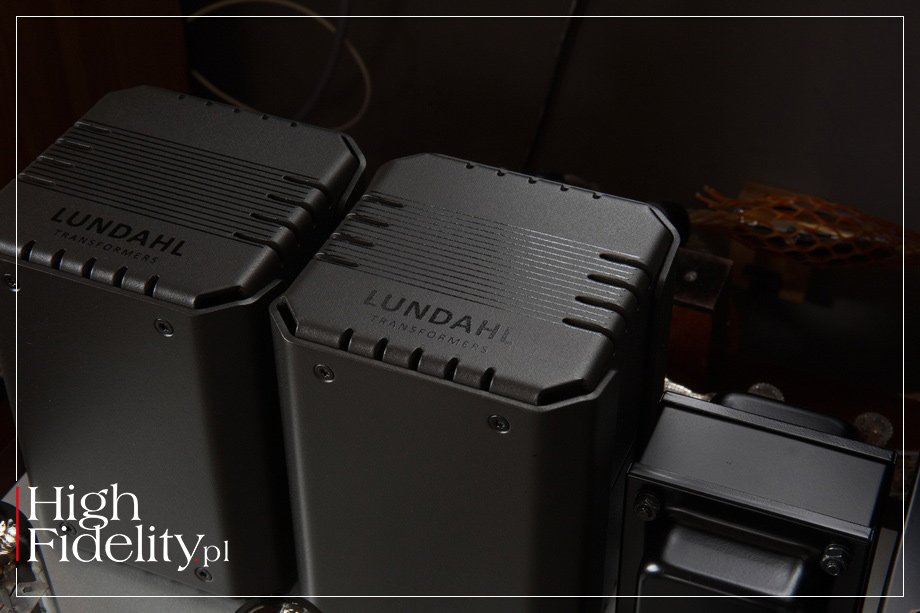
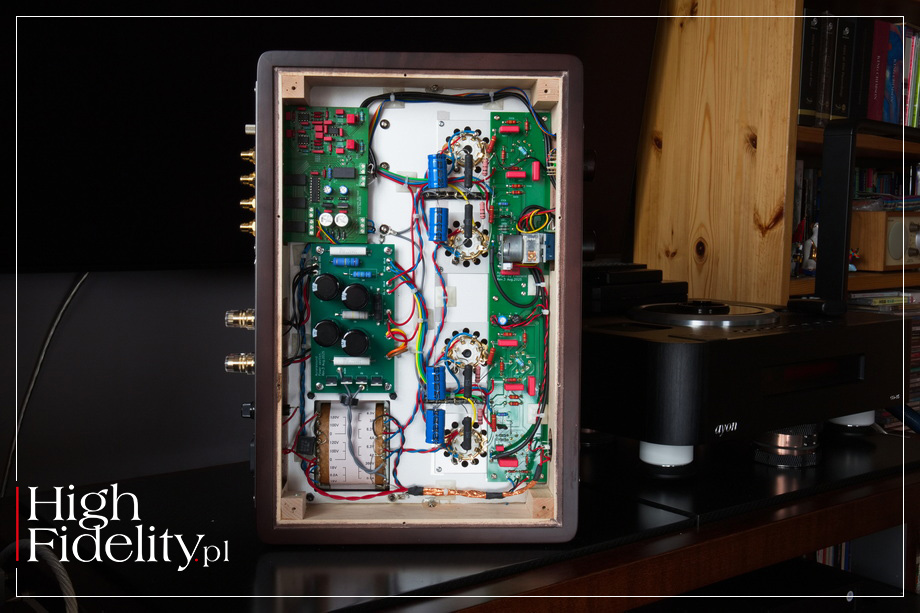
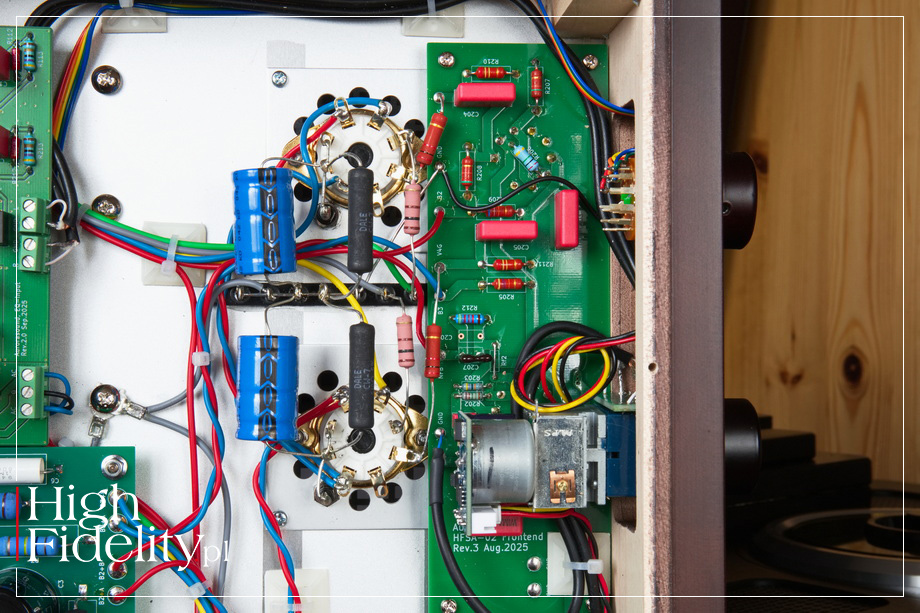
TECHNOLOGY • As we mentioned, the amplifier features a traditional amplifying circuit. The input stage uses ECC83 (12AX7) dual triodes, with both sections connected in parallel to lower the output impedance, reduce noise, and increase the power required to drive the next stage. The phase inverter stage uses tubes invented by Mullard, the ECC82 (12AU7) dual triodes. Unfortunately, all the tubes come from Russia—they are Electro-Harmonix tubes. The EL34 output tubes are from the same source. In the output stage, there are very nice, truly high-quality output transformers from the Swedish company Lundahl. We usually see this name on small balancing or step-up transformers. In such a large form, they are a rarity. Next to them is a large toroidal transformer and a choke—the anode power supply operates in a “Pi” configuration. The manufacturer states that, if desired, the output tubes can be replaced with other brands “without the need for adjustment.” Near the socket of each tube—the sockets are high-quality, gold-plated—there is a bias voltage check point that allows you to verify the condition of the tubes:
By using conventional circuits and standard vacuum tubes, we have ensured stable operation and maintenance-free performance for many years.
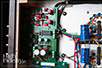
⸜ Ibidem. The circuit’s assembly is a hybrid, meaning it uses both point-to-point wiring and printed circuit boards. The former can be seen in the power amplifier assembly, while the latter is used in the preamplifier and power supply. And you can also see some nice passive components there. Mr. Karaki points out resistors from Vishay, PRP, and the Japanese company Takuman, film (polypropylene) capacitors from Wima, and TDK-EPCOS as the manufacturer of electrolytic capacitors. Volume is controlled by a malachite-colored Alps potentiometer. 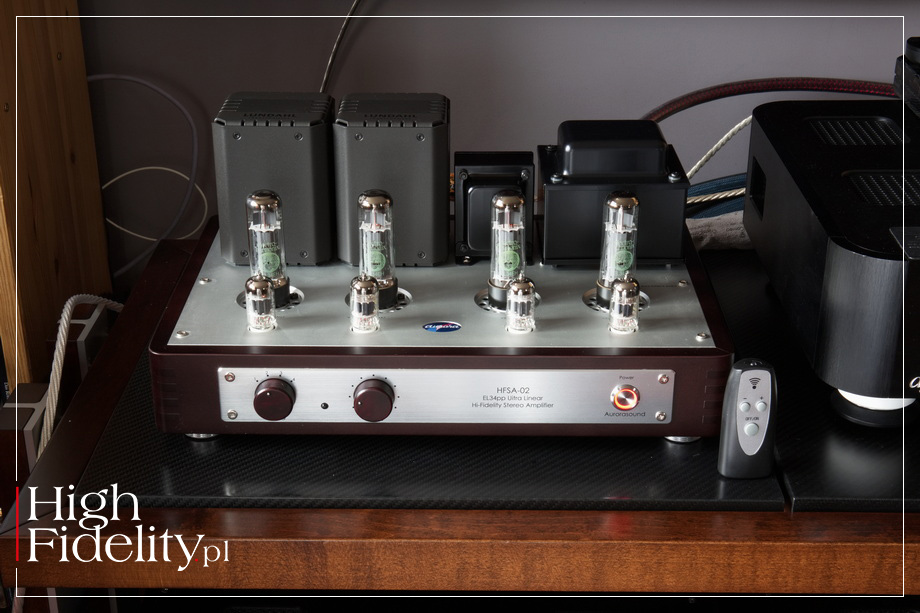
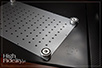
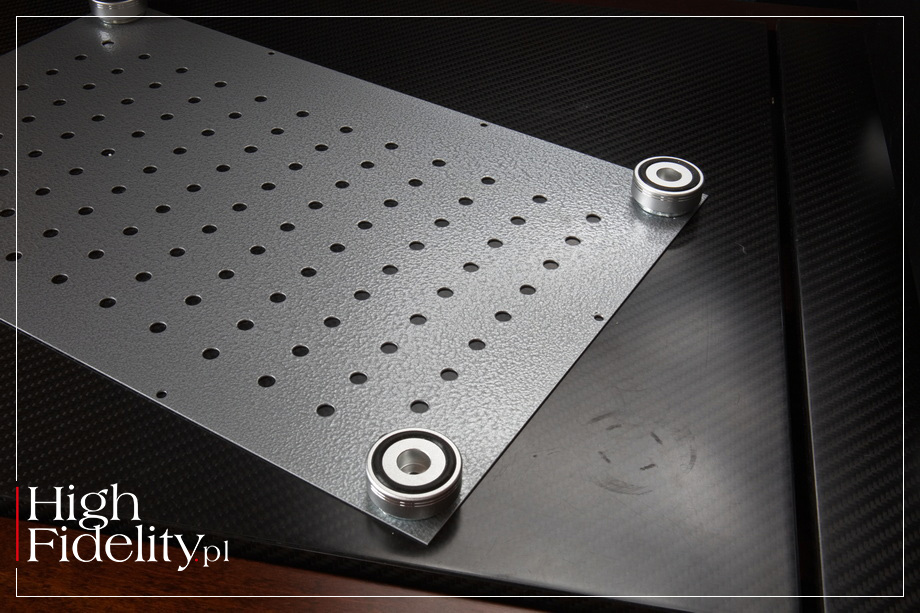
According to the report, the company based its selection of these components on their “quality and reliability”. The power transformer and choke were customized to meet the specifications sent to Sweden by Aurorasound. The rectifier diodes, on the other hand, are made of ROHM silicon carbide, which is characterized by the lowest noise level among other components of this type and high resistance to voltage spikes. The speaker outputs and RCA jacks, covered with a “thick layer of gold,” are also said to be “carefully selected.” The set includes a metal cage that protects the tubes. Usually, this element looks out of place, but here, lo and behold, it actually fits in, just like the bottom panel finished with “hammered” lacquer. ▓ SOUND HOW WE LISTENED • The Aurorasound HFSA-02 amplifier was tested in the HIGH FIDELITY reference system and compared to a two-box system, consisting of the Ayon Audio Spheris Evo tube preamplifier and the Soulution 710 transistor power amplifier. I devoted a separate listening session to comparing it with the Audio Research Corporation I/70 amplifier. 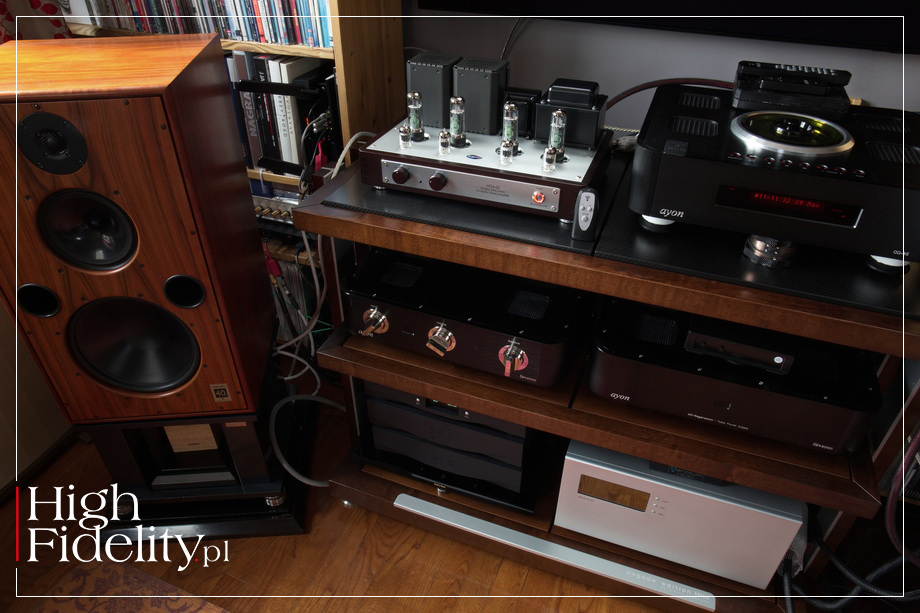
The HFSA-02 was placed on a Finite Elemente Master Reference Pagode Edition Mk II rack. It was connected to the Ayon Audio CD-35 SACD player via Crystal Cable Absolute Dream RCA interconnects and to the Harbeth M40.1 speakers via Art Series Da Vinci cables from the same manufacturer. The amplifier was powered by an Acrolink Mexcel 7N-PC9500 cable. The system also included SPEC RSP-901EX speaker filters that its manufacturer calls REAL-SOUND PROCESSOR; review → HERE. 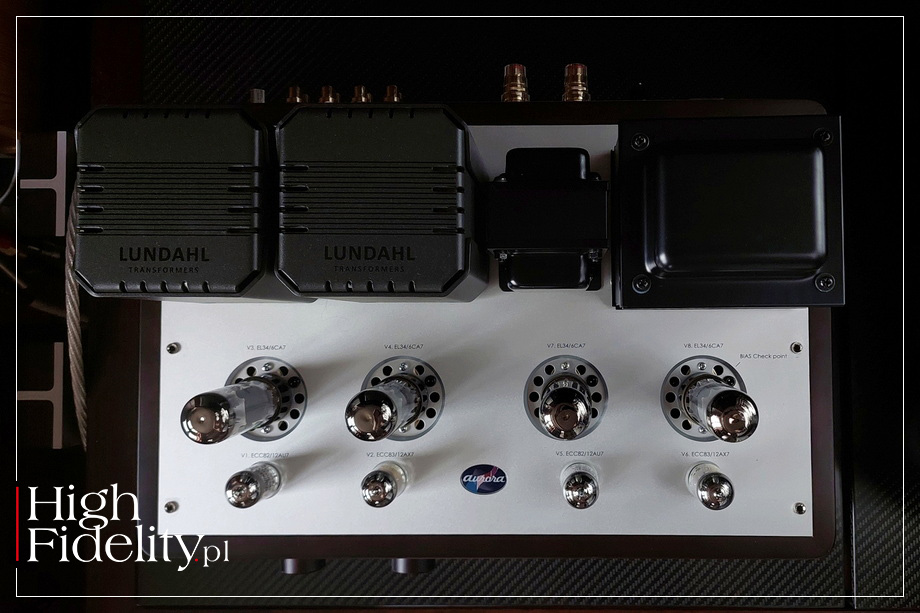
To evaluate the phono preamp card, I used a Rega P8 turntable with a Shelter 201 cartridge. It’s an affordable MM model, but a really nice one. The HFSA-02 has an MM input, but—as I see it—the idea is to pair it with a step-up transformer and use MC cartridges. To avoid introducing another variable into the system, I stuck with the MM input, which was compared to the MM section in the RCM Audio Sensor Prelude IC preamp. » RECORDINGS USED FOR THE TEST ⸜ a selection
→ COMPACT DISC |
→ LONG PLAY WHEN MR. KARAKI REFERRED TO THE HFSA-02 amplifier as “orthodox,” he was referring not only to its design and appearance, but also to its sound – at least that’s how I see it. Softness, silkiness, and fluidity—this three qualities appeared in my notes throughout the whole time I spent with this device. And it was a well-coordinated trio, like KELLY’s trio accompanying WES MONTGOMERY on the Smokin’ At The Half Note. By “well-coordinated,” I meant the fluidity with which this Japanese device blended sounds into a single whole. Although it is a tube amplifier with a power output of just over thirty watts per channel, it had no trouble driving the demanding Harbeth speakers to a level where the sound was full, had plenty of volume, and still wasn’t overdriven. The closer it got to the latter, the softer the device sounded. So it won’t be the case that, put off by the sound, we’ll postpone the listening session for another day. We’ll simply turn the volume down. 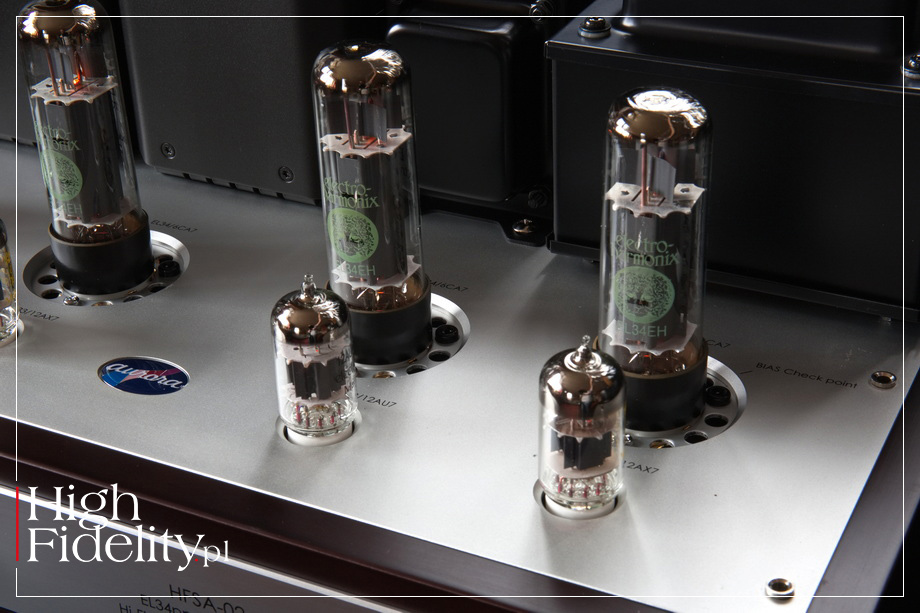
I would say that the designer was aiming for the opposite of being put off: it is meant to entice, attract, and keep you listening longer. That is where the inner warmth of the recordings came from, and that is why the drum brushes in ˻ 2 ˺ Love Letters on DIANA KRALL’s album The Look of Lovewere so appealing, so enticing. Just like the pianist’s voice, which softly settled in my ears, l like the song of a siren, almost… The amplifier delivers a surprisingly wide frequency response, ranging from the highest treble to the quite low bass. The manufacturer’s HFSA-01 amplifier, with half the power output, seemed more energetic and dynamic. However, the smaller sibling of the tested model also entered clipping faster and did not create such large and three-dimensional phantom images. The HFSA-02 has significantly higher power headroom, which is clearly evident in recordings that require not only a quick response to the signal but also sustaining the signal for an extended period. You don’t need to resort to large-scale symphonic works to hear this—though I did listen to a few albums from this genre—nor to heavy rock, though it was easily discernible even with the RED HOT CHILI PEPPERS. The best of what the amplifier can conjure up from the material—that’s how I see it—we’ll hear with small ensembles, with minimalist recordings. The amplifier’s ability to create expansive soundscapes and convey a vast volume of sound comes through perfectly with them. And it does so in an incredibly elegant yet internally complex way. So it was with genuine pleasure that I listened to a few tracks from HARUOMI HOSONO’s album, titled Hosono House. It is a unique album, and the artist himself is extraordinary. Hosono-san is considered one of the pioneers of contemporary Japanese pop, electronic, and city pop music, and as the leader of the Yellow Magic Orchestra, he contributed to the creation and development of many genres of electronic music. The album in question was recorded almost entirely—except for the brass tracks added later—in his 13.4 m² bedroom, using an amateur Sony reel-to-reel tape recorder. The result of these techniques is remarkable. It’s an intimate performance with instruments played very close to the microphones, featuring significant background noise, yet with an extraordinary sense of presence and naturalness. This would be an equally apt description of the album as it is of the amplifier under review. It beautifully evoked that heated atmosphere (imagine a few people stuck for five hours in such a small room with the windows closed) and a sense of freedom. It was as if there were no dynamic or tonal limitations in this sound. Effortlessness is thus another element of the sound of the reviewed amplifier, following refinement, fullness, softness, and fluidity. It doesn’t flaunt a bright treble, nor does it even attempt to present it selectively. Yet with both the Krall and Red Hot albums, as well as the aforementioned record, the cymbals were clear and dense. I would say they were powerful, but I don’t mean power in the sense of “quantity.” It would be power in the context of “intensity.” Although similar in meaning, they are not synonyms. In the latter case, it’s about the entire sound, not just its attack. This Japanese amplifier will therefore reproduce the density of the music and its inner energy very well. Take, for example, ˻ 3 ˺ Bad Wolfs from the latest album by PUCIFIER, the band led by the lead singer of Tool. The presentation was vast, spacious, and rich. But it wasn’t particularly selective or precise in delineating the boundaries between sound sources. The kick drum hit hard, almost powerfully, with a distinct decay, but it wasn’t a quick snap. Everything I’ve described above leads to the conclusion that this is an amplifier with a distinctly shaped sound: warm, fluid, and dynamic—but dynamic in its internal energy and scale, rather than through sudden changes. And beautiful in terms of tonal reproduction. But it also focuses on the big picture rather than a precise image of the instruments, painting broad strokes without holographic detail where we can pinpoint exactly whether it’s Art Farmer’s trumpet or Jackie McLean’s saxophone on Sonny Clark’s album Cool Struttin’. It’s not that the imaging is blurry—that’s not the point. I’m talking about the way the sound is constructed—it has fullness and density, and no sharp edges. Because the Aurorasund delivers such a detailed sound, everything falls into place; one element flows naturally from another. It’s as if it had been arranged beforehand and was just waiting for its moment—the moment when the amplifier sends the signal to the speakers. The downside of such a presentation is that it is not an “audiophile” sound. During a brief listening session, we’ll find it hard to explain to our friends why we are audiophiles. There is no spectacular “wow” factor in this presentation, no moment of suspension where we are suddenly surprised by a wealth of sounds in a single second. On the other hand, however, this is a sound we will want to be with for a long time. The absence of a “wow” is not a lack of emotion, but merely a spreading of those emotions over time. 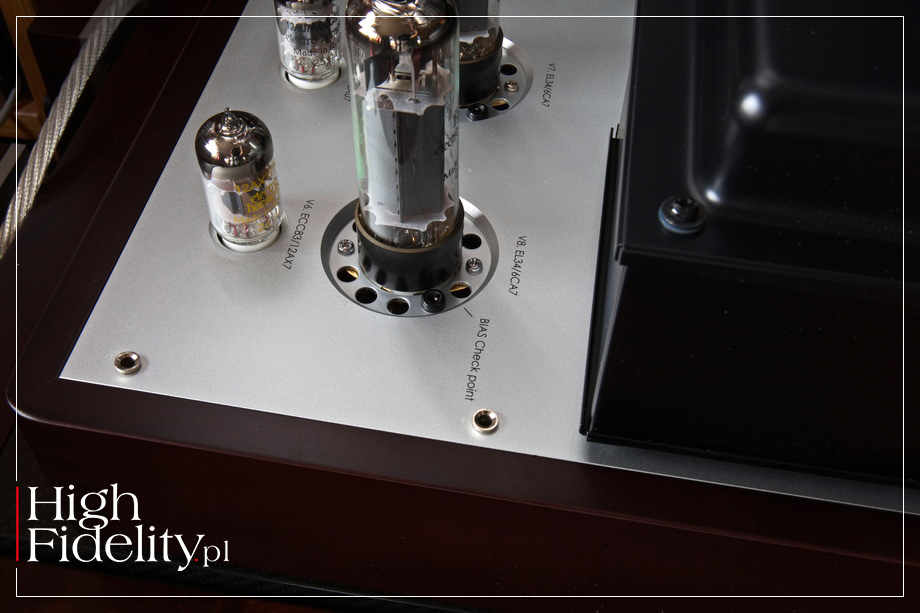
Just play some music for a while—say˻ 1 ˺ High For This from THE WEEKND’s album House of Baloons, and you’ll hear a powerful, extremely low-frequency bass and a deep soundstage where the vocals fade away at the very end of the track. And when the first synth notes of ˻ 2 ˺ What You Need kick in, the space will suddenly fill up, taking in more than we could have expected. It’s as if the amplifier were creating a dense membrane between us and the speakers, rather than air. TURNTABLE • The phono input is something worth considering right away when purchasing the Aurorasund amplifier. You could opt for an external phono preamp—the company does offer them, after all—but it’s not necessary. At least not at first. The device sounded perfectly old school, so to speak, fitting right in with the amplifier’s own sound. With the Shelter 201 cartridge—which is, after all, affordable, even cheap in this context—Thelonious Monk and Gerry Mulligan’s Mulligan Meets Monk, released by Analogue Productions in 2004, sounded warm and low-centered. It was a sound with a saturated midrange and a tonal balance set quite low. There was directness and naturalness to it, though these did not stem from any particular selectivity or transparency. With expensive cartridges and step-up transformers, the performance will be much better in every respect. The overall sound will, however, keep the proportions I’m describing. That is, with a sepia-toned character. So this is not an audiophile sound—or, even less so, a hi-fi one. It’s the kind of sound many music lovers dream of but are unable to achieve. By using an external preamp, we’ll get a brighter and more nuanced sound. But is it worth it? In my opinion, if music is the meaning of life for us and we don’t want to over-complicate our system, this Japanese amplifier will work wonderfully with a phono preamp module. Let’s consider an HO MC cartridge or a step-up transformer, and we’ll open another door. But even with such a basic cartridge, the amplifier will sound great—rich, deep, and warm. Just the way we imagine it when we say “analog sound.” The dynamics will be moderate, and the details won’t overwhelm us. But it’s a trade-off. In my opinion, it’s worth it. ▓ Summary MR. KARAKI’S NEW AMPLIFIER is a beautiful example of how audio builds musical worlds using various methods. Completely different from the “01,” it offers an experience of music at a deeper level. Listening to it won’t be explosive or exciting in isolated moments. It will be an experience that transports us to other realms and draws us in with its density, fullness—simply put: its “substance.” The sound from the tested amplifier is, in fact, warm, smooth, and coherent. The bass extends very low and is surprisingly well-controlled for a design using EL34 tubes. This allows both the intimate ˻ 1 ˺ Rock-a-Bye My Baby from the Hosono album, as well as the club track such as ˻ 2 ˺ Gala from XG by THE CORE - 核 to sound beautifully. The “02” is a very versatile device. 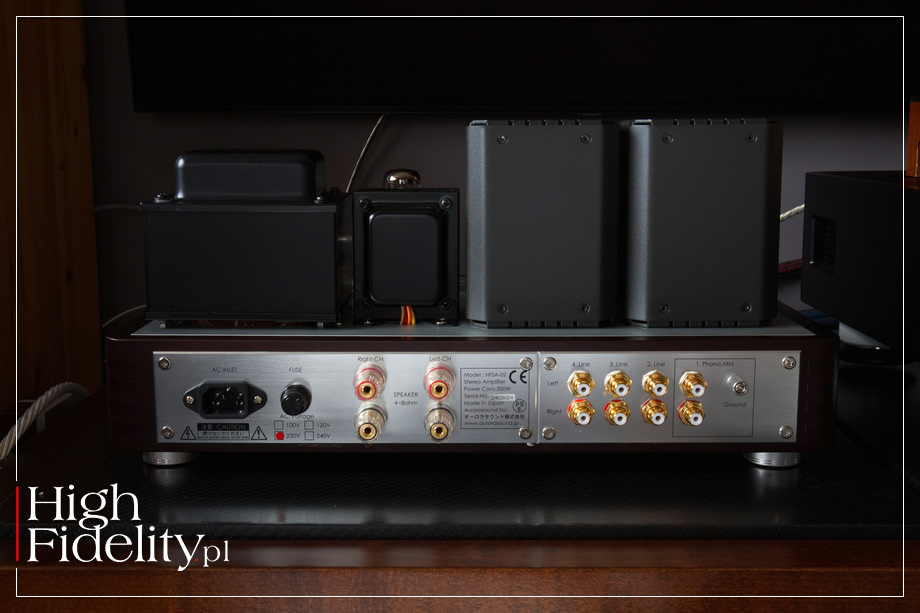
There is also a kind of internal balance in this sound. You can clearly hear the choices made by the designer, such as boosting the lower midrange and rolling off the upper treble, for example. As I listened to one album after another, I became certain that these were conscious choices, part of Mr. Karaki’s musical world. And it is a beautiful world; you can be sure of that. Perhaps you would like to experience this beauty in your own home every day? – If so, if you’re not looking for audiophile thrills in music but rather musical richness, a listening session with the Aurorasound HPSA-02 amplifier is a must. ‖ WP ▒ Technical specifications (according to the manufacturer)
• Nominal output power: 2 x 31 W/8 Ω 
THIS TEST HAS BEEN DESIGNED ACCORDING TO THE GUIDELINES adopted by the Association of International Audiophile Publications, an international audio press association concerned with ethical and professional standards in our industry, of which HIGH FIDELITY is a founding member. More about the association and its constituent titles → HERE. |
 |

|
Reference system 2026 |
|
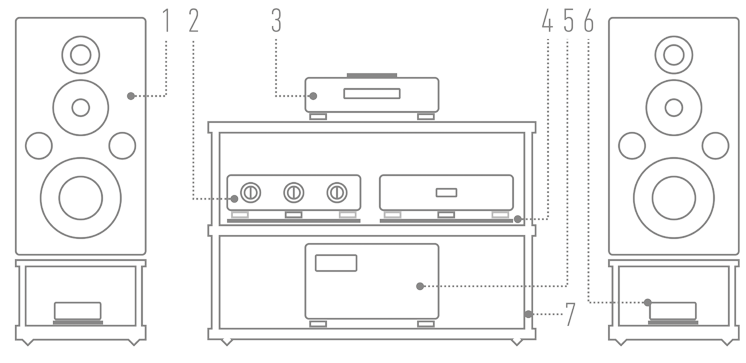 1) Loudspeakers: HARBETH M40.1 |REVIEW| 2) Line preamplifier: AYON AUDIO Spheris III Linestage |REVIEW| 3) Super Audio CD Player: AYON AUDIO CD-35 HF Edition No. 01/50 |REVIEW| 4) Stands (loudspeakers): ACOUSTIC REVIVE (custom) |ABOUT| 5) Power amplifier: SOULUTION 710 6) Loudspeaker filter: SPEC REAL-SOUND PROCESSOR RSP-AZ9EX (prototype) |REVIEW| 7) Hi-Fi rack: Hi-Fi rack: finite elemente MASTER REFERENCE PAGODE EDITION Mk II, more → HERE |
|

|
Cables Analog interconnect SACD Player - Line preamplifier: SILTECH Triple Crown (1 m) |ABOUT|» ANALOG INTERCONNECT Line preamplifier → Power amplifier: Siltech ROYAL SINLGE CROWN RCA; review → HERE Speaker cable: SILTECH Triple Crown (2.5 m) |ABOUT| |

|
AC Power Power cable | Mains Power Distribution Block - SACD Player: SILTECH Triple CrownPower (2 m) |ARTICLE| » POWER CABLE Mains Power Distribution Block → Line preamplifier: Acoustic Revive ABSOLUTE-POWER CORD, review → HERE » POWER CABLE Mains Power Distribution Block → Power amplifier: Acoustic Revive ABSOLUTE-POWER CORD, review → HERE Power cable | Power Receptacle - Mains Power Distribution Block: ACROLINK Mexcel 7N-PC9500 (2 m) |ARTICLE| Power Receptacle: Acoustic Revive RTP-4eu ULTIMATE |REVIEW| » ANTI-VIBRATION PLATFORM under Acoustic Revive RTP-4eu ULTIMATE: Graphite Audio CLASSIC 100 ULTRA, review → HERE Power Supply Conditioner: Acoustic Revive RPC-1 |REVIEW| Power Supply Conditioner: Acoustic Revive RAS-14 Triple-C |REVIEW| Passive filter EMI/RFI: VERICTUM Block |REVIEW| |

|
Anti-vibration Speaker stands: ACOUSTIC REVIVE (custom)Hi-Fi rack: finite elemente MASTER REFERENCE PAGODE EDITION Mk II, more → HERE Anti-vibration platforms: ACOUSTIC REVIVE RAF-48H |ARTICLE| » ANTI-VIBRATIONAL FEET: |

|
Analogue Phono preamplifier: Phono cartridges:
Clamp: PATHE WINGS Titanium PW-Ti 770 | Limited Edition Record mats:
|

|
Headphones » HEADPHONE AMPLIFIER: Leben CS-600X, review → HEREHeadphones: Headphone Cables: Forza AudioWorks NOIR HYBRID HPC |