


|
LINESTAGE & POWER AMPLIFIER ⸜ monaural FEZZ AUDIO
Manufacturer: FEZZ AUDIO |

 |
 |
 |
|
Review
text by WOJCIECH PACUŁA |

|
No 261 February 1, 2026 |
|
˻ PREMIERE REVIEW ˼
NOT LONG AGO, High Fidelity tested amplifiers that were part of a larger series, built slowly, step by step. Usually, the manufacturer first develops an integrated amplifier, and only later offers a preamplifier and a stereo power amplifier based on it, and finally monoblocks (monaural power amplifiers) matched to this preamplifier. 
However, it so happens that both companies I have in mind, namely Divaldi with its Gold series and Fezz, did the opposite – they first offered separate systems and only then an integrated amplifier. When testing the Olympia Evo model, Maciek Lachowski, co-owner and one of the designers of the company, said that it was a natural consequence of the evolution of Olympia monoblocks available in Fezz's lineup for six months at that time. And further:
Given that we manufacture our amplifiers in several standard sizes, we couldn't have as much space as we would have in a new, larger chassis. The location and size of each component had to be carefully considered so they would not interfere with each other, and the output transformers or sensitive input circuits would not pick up interference from chokes or power supply sections. I am pleased to say that we succeeded, and achieved excellent results.
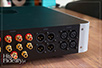
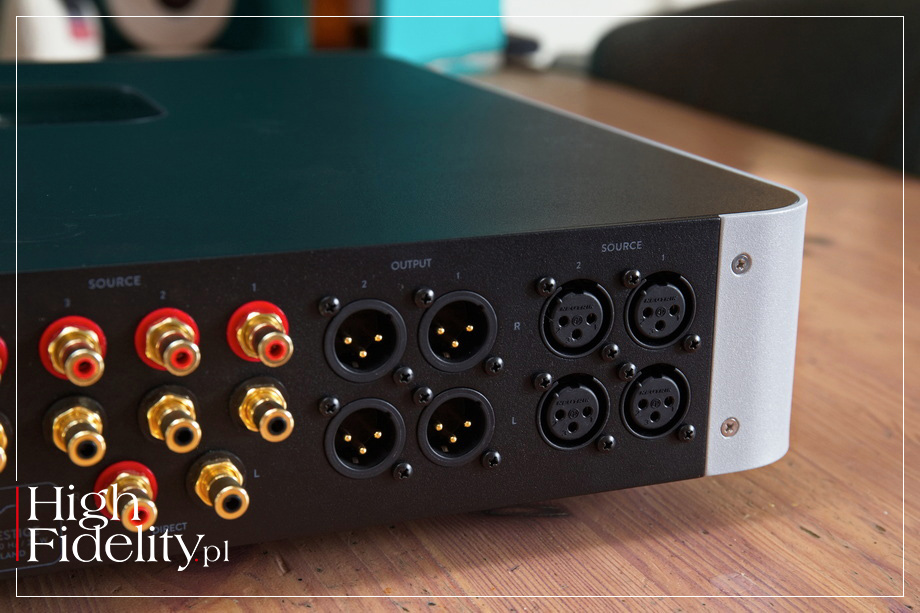
Last year, young engineer named Jakub Korpacz joined our team. And it is thanks to his ingenuity that we have taken Olympia to the highest technical level in the history of Fezz Audio. ⸜ WOJCIECH PACUŁA, Fezz Audio Olympia. Test, „High Fidelity” № 251, 16 March 2025, → HIGHFIDELITY.pl, accessed: 4.09.2025. ▌ SAGITA PRESTIGE EVO SPLITTING AN AMPLIFIER into separate preamplifier and a power amplifier offers several advantages and three disadvantages. Since the advantages outweigh cons, manufacturers often use this solution, especially in higher price ranges. This is because a split system is generally more expensive than a corresponding integrated amplifier. In the case of the tested system, it would be PLN 52,800 compared to PLN 23,900 for the Olympia in a single chassis; review → HERE. Among the advantages of using separate preamplifier and power amp is the electrical and mechanical separation of the low-level section (preamplifier) and the current section (power amplifier). A separate power supply (with two power cables) also eliminates the effect of voltage modulation affecting the preamplifier caused by large, sudden changes in power consumption by the power amplifier. Cons? – No common ground, the need to run the signal through long interconnects and a need for two power cables, which makes it more expensive. FEATURES • Sagita Prestige Evo is the first tube line stage in Fezz Audio range to feature balanced XLR inputs and outputs. The device descriptions one finds on stores websites, therefore, state that it is a balanced device. I asked Maciek Lachowski about it, as I was curious to know how the signal is amplified when using RCA inputs. To my question, “Is the signal carried symmetrically from input to output?”, he replied briefly: “No. The signal is desymmetrized at the input and symmetrized at the output.” The device features four RCA inputs, including one “direct” input, and two balanced XLR inputs – a total of six line inputs. The “direct” input allows you to bypass the volume control circuits and amplifier in your home theater system. The signal is sent out either through the RCA or XLR outputs. There are a total of eight outputs: four RCA and four XLR. They can be used to connect up to four power amplifiers in the system, for example, in a bi-amping system. The presence of XLR inputs does not mean that it is a balanced system. 
The device can be controlled using two large knobs on the front panel or a remote control. After major problems with previous remote controls, the company switched to a new platform offered by another subcontractor. The new remote control allows you to adjust the volume, select the source, and turn the device on and off. Its body is made of milled aluminum. The buttons work reliably, although – as I already mentioned in my review of the integrated amplifier – they are a bit loose in their holes. One thing is missing – a “Mute” button. And maybe a pad so that it can be safely placed on a delicate surface. The remote control is only available in silver. The device looks great, but Fezz has already gotten us used to that. All devices with the Evo label use a design created by Tomasz Pydo, Katarzyna Borkowska, Jacek Nosił, and Jan Wilczak, and I should mention, that the Polish manufacturer received the prestigious Red Dot award in 2023 for it. Another new feature for this series was the logo, designed by Dominika Wysogląd; more → HERE ˻PL˺. Not only are they attractive, but you can also choose from seven (!) chassis finishes. TECHNOLOGY • The tested preamplifier is built around two, as the manufacturer assures us, “specially selected,” low-noise 12AU7/ECC82 tubes. You can see them behind a ‘window’ at the top of the device and ‘enjoy the view’, but at the same time they are not exposed. They can be accessed by sliding a magnetically attached glass plate. The following information is provided about the selected tubes:
They ensure harmony and precision of sound, enhanced with ‘tube tone’. An aluminum remote control allows you to adjust the volume (we use blue Alps potentiometer) and select sources (Takamisawa relays with silver-plated contacts). An important part of the power supply section is the audio-grade toroidal transformer.
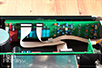
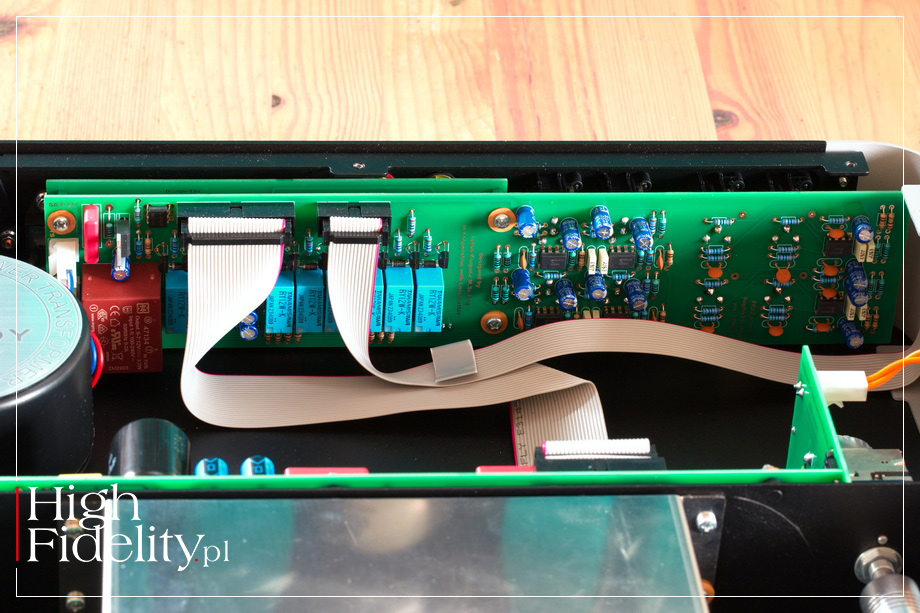
⸜ Sagita Prestige Evo, → FEZZAUDIO.com, accessed: 4.09.2025. The preamplifier is not only visually attractive, but also compact, measuring 420 x 380 x 95 mm and weighing 10 kg. Its chassis is made of precisely manufactured and fitted steel plates bolted to a steel frame. It is available in several colors, and in each case, the paintwork is of very high quality. There are two large metal knobs on the front panel for adjusting the volume and input selection. Two of them are also switches used to activate the device from standby mode and mute mode. Notice that in all color versions the knobs are silver. The laser-cut logo in the center is illuminated – the LEDs are enclosed in an aluminum block. The power switch is located at the bottom, near the front edge. The device stands on four nice-looking rubber feet. At the rear, we find RCA inputs and outputs using good quality sockets. It is worth remembering that Fezz Audio mounts them in reverse to the current standard, i.e., the right channel (red) is at the top and the left channel (black) is at the bottom. There is also a ground switch here, connecting or disconnecting it form the chassis. It is worth trying both positions and determining which sound you like better. In some cases, it will allow you to reduce noise in the system. The circuit is assembled on several specialized PCBs. The tube section is enclosed in a screen and separated from the main amplifier circuit. The input section features Texas Instruments LM4562NA integrated circuits, and the signal is attenuated using an ALPS potentiometer. The tubes operate in the output buffer. They are accessible behind a sliding glass panel on the top of the device. The preamplifier is controlled either by knobs on the front panel – two of which are also switches – or by a remote control. ▌ OLYMPIA EVO MONO OLYMPIA EVO MONO are power amplifiers monaural ones. Each weighs 17 kg and measures 355 x 380 x 195 mm. Each features four KT88 tubes operating in a parallel push-pull configuration, which allows for an output of up to 150 W per channel. One of the key elements of this model is a unique microprocessor-controlled bias system, which not only simplifies operation but also significantly increases the reliability of the device. Due to this solution, as we read, users “can fully focus on enjoying music without worrying whether the device operates properly.” 
The designer of the circuit, Mr. Jakub Korpacz, wrote about the bias control circuits that these modules were developed in collaboration with Andrzej Starzyk, the owner and designer of Looptrotter, a company that manufactures technically advanced equipment for the pro audio industry, and that they “combine the advantages of fixed bias and the maintenance-free nature of automatic bias.” He added that in Olympia Dual Mono, he decided for an „analog” approach to this issue. So he designed a continuous automation system that performs the same task without entering the digital world. And further:
It is fair to say, that the auto bias circuit is the heart of this amplifier and that it is this circuit, in combination with the balanced architecture of the entire amplifier (all tubes operate as differential stages), that is responsible for its performance. The challenge was to design a circuit that would be insensitive to the presence or absence of a music signal.
The variable component of the bias current (audio signal) interferes with most solutions of this type, causing an increase in distortion and shifting the amplifier's operating point to deep class B. The key was to develop an integrating circuit that would operate only in a very narrow range and thus be transparent from the point of view of the audio signal. ⸜ Ibidem. The amplifiers are built similarly to other devices from this company, i.e., very solidly. They also represent a classic design for this type of product – a low chassis with power and output transformer cans and tubes placed on top. These are inserted from above into gold-plated sockets with ceramic bases. Their markings are applied with black, glossy varnish, so they are discreet. Between them, there are also red LEDs indicating the activation of the automatic protection system. According to the manufacturer, the output transformers produced by the parent company Toroidy.pl use toroidal cores and are characterized by “very low inductance leakage, unattainable for standard transformers.” This is supposed to guarantee a wide and flat frequency response, and the amplifier “enters a realm of power and distortion levels previously unattainable for tube amplifiers.” The power transformer and choke (!) are also toroidal designs. 
The input and phase inverter circuits use popular double triodes, ECC82 and ECC83. In the reviewed model, these were TAD, and Russian Genalec tubes from the Golden Lion series, CV4004 version, respectively. The CV4004 symbol was the British government's code for a special version of the Commercial M8137 ECC83 dual audio triode, intended for military applications, i.e., with extended life and lower noise and microphonics. TAD, on the other hand, is a German brand owned by Tube Amp Doctor, which selects and matches tubes, marking them with its own labels. |
Until recently, the Olympia Evo Mono were the most powerful amplifiers in this manufacturer's range, offering, as we said, up to 150 W per channel, with low distortion of less than 0.1% below 100 W and less than 1% at full power. The manufacturer also specifies a wide frequency response range for a tube amplifier, namely from 16 Hz to 80 kHz. Let's add that the Magnetar series monoblock delivers as much as 200 W per channel (!). The tubes in this device are electronically protected rather than using traditional fuses. This solution, together with a system that delays the application of anode voltage, should reassure those who associate tube amplifiers with difficult operation and unreliability. The same applies to the automatic bias control and correction system, which, according to the manufacturer, “ensures optimal sound quality and eliminates the need for adjustment.” The signal is fed to the amplifier via one of two line inputs – RCA or XLR – a small toggle switch allows you to switch between them. Similar to the preamplifier, the power amplifier also is an unbalanced design. The XLR input is there for convenience and so that the amplifiers can be located further away from the preamplifier than usual, where a balanced connection may make sense. The signal from the XLR input is desymmetrized using a small, custom-made transformer. ▌ SOUND HOW WE LISTENED • Sagita Prestige Evo preamplifier and Olympia Evo Mono power amplifiers from Fezz Audio were tested in HIGH FIDELITY's reference system and compared to a reference system consisting of an Ayon Audio Spheris Evo tube preamplifier and a Soulution 710 transistor power amplifier. 
The tested device was placed on a Finite Elemente Master Reference Pagode Edition Mk II rack. The sources used for this test were Ayon Audio CD-35 HF Edition SACD player and a Sforzato DSP-05EX file player with a PMC-05EX clock. Ayon and Olympia were connected using Siltech Triple Crown RCA interconnects, and the Lumin via Siltech Single Crown interconnects. The monoblocks drove the Harbeth M40.1 speakers using Crystal Cable Art Series Da Vinci cables. The preamplifier was powered using Acrolink Mexcel 7N-PC9100 cable, and the power amplifiers by Essential Audio Tools Current Conductor S. Let me add that the speakers were connected to SPEC RSP-901EX speaker filters, or Real-Sound Processor (more → HERE) as their manufacturer calls them. 
» ALBUMS USED FOR THE TEST ⸜ a selection
⸜ JOHN SCOFIELD, DAVE HOLLAND, Memories of Home, ECM Records/Tidal, FLAC 24/96 ⸜ 2025. EVERYTHING I HEARD with the Olympia integrated amplifier, repeated with the tested set. That is: fullness, warmth, and complete tranquility. This amplifier plays with truly beautiful tones, engaging in the presentation, even slightly enhancing it. Let me explain what I mean. When in the song ˻ 1 ˺ Memories of Home, from the latest album by JOHN SCOFIELD and DAVE HOLLAND of the same title, released by ECM Records, a double bass solo comes in, and it is a SOLO, not a fake. In the sense that it is powerful, vibrant, and tangible. The presentation is large, densely filling the space between the speakers, even though the instruments are positioned close to each other, almost on the same axis. The reverberations and volume of the sound make it seem as if it starts in the left speaker and ends in the right. And all the space between them is energized; there are no breaks or gaps. It's as if the whole air is playing, not just selected points. Sagita with Olympias is a system that plays warmly. That's for sure. But it is also resolving. Because when I heard the first notes of the piano opening RYO FUKUI's piece entitled ˻ 1 ˺ Early Summer, I also heard a slight tape hiss and the bright sound of the instrument. This is a completely different recording from the previous one, in the style of Three Blind Mice from the same period. So it is sonorous and, above all, energetic. Fezz showed this difference precisely, without hesitation. So it wasn't a matter of covering up the differences with warmth. But it also put something like a golden “haze” over the whole thing. This was done by rounding off the attack and boosting the lower midrange. It is also important that this is a device that plays low and powerful bass, which allows it to create such a large volume of sound. And it helps to fill the midrange and high frequencies. This is a well-known phenomenon, although many audiophile music lovers still do not realize how important it is for proper reproduction, for example, of percussion cymbals, the way the system behaves below, say, 120 Hz. And here, in the amplifier we are testing, this cooperation is exceptionally good. We get a coherent, not exaggerated, but rich sound. Coherent not only in terms of tone, because the flow is exceptional, as in the wonderful track ˻ 12 ˺ Melancholia from RICK WAKEMAN's new album, but also rushes, pushes forward in an orderly way, as in STEVIE WONDER’S ˻ 1 ˺ Keep On Running from the excellent album Music Of My Mind. 
The latter does not seem particularly saturated at the bottom of the range, yet it was very “effective”. Because when the reverb changed on the vocals, or the musician moved closer to or further away from the microphone, you could hear the tone change as well, the result of the “proximity effect.” The fast, almost nervous tempo of this piece was also very well maintained. Without emphasizing the attack or sharpening the sound, it was clear and steady. As I said, this is not an album with particularly powerful bass; it focuses primarily on the midrange. But, as with Fukui's album, you could hear that everything was working well with the Fezz amplifier, that everything was presented in in a proper order. If you want to check it for yourself, play ARVE HENRIKSEN's ˻ 1 ˺ Echoes from the Shore. It's a combination of the intimate sound of the trumpet with electronics and percussion instruments. And the bass is low, really low! Fezz conveys it almost as low as the Harbeth M40.1s go. And at the same time, it doesn't overshadow the higher parts of the range; it doesn't muddy them. The bells that sound at the end of the track are bells that the drummer casually runs over, with electronic sound still running underneath. And it wasn't aggressive with Fezz set. I didn't feel like turning down the volume knob. On the contrary, I turned it up to hear more and more. This is not a selective bass. If that's what you're looking for, it's probably not the best choice. Everything is fine with it; it doesn't drag on, and it doesn't clutter the sound with “gurgling.” And yet, a moment with the double bass, for example in 1 ˺ For María Joseé from AARON PARKS' album recorded for Blue Note, and we know, hear and feel that this is simply the character, the beauty of this system. Beauty, we might add, that is extraordinary and stands out from the crowd. If I had to point something out in this context, it would be the combination of rich tone, extended and full bass, and perfect order. It is not a selective sound, and the instruments on stage are not separated in any particularly clear way. But this is exactly the sound we imagine when we hear the word “tube.” It is a perfect, truly successful transfer of this concept from the realm of abstraction to the real world. ▌ Summary THAT IS WHY, IN RESPONSE TO THE unasked question: “Why do I need a system when the Olympia integrated amplifier is so great?” – unasked, but hanging in the air like a huge banner, I will say the following: we get the same performance as with an integrated amplifier, only more. There is more of everything here in the same space: color, dynamics, bass, separation, intimacy, and rhythm. This is because the system is more resolving and has higher power. And power means freedom when choosing speakers. 
And that's what this amplifier is like: it offers a tube sound, an effortless one at that, it offers tangibility and mass of the sound. And it is very well made. And it's pretty. I don't know what more we need in audio. Unless we're always have to nitpick. In that case, the Fezz Audio system, consisting of the Sagita Prestige Evo preamplifier and Olympia Evo Mono monophonic power amplifiers, won't help us. For that, we'll need a doctor... ● ▌ Technical specifications (acc. to the manufacturer)
‖ Sagita Prestige Evo 
THIS TEST HAS BEEN DESIGNED ACCORDING TO THE GUIDELINES adopted by the Association of International Audiophile Publications, an international audio press association concerned with ethical and professional standards in our industry, of which HIGH FIDELITY is a founding member. More about the association and its constituent titles → HERE. |
 |












|
Reference system 2026 |
|
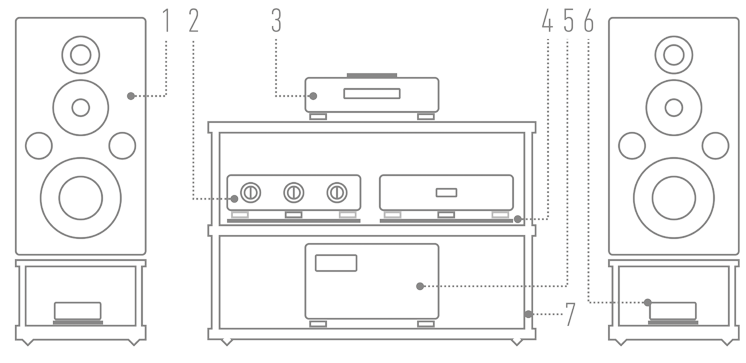 1) Loudspeakers: HARBETH M40.1 |REVIEW| 2) Line preamplifier: AYON AUDIO Spheris III Linestage |REVIEW| 3) Super Audio CD Player: AYON AUDIO CD-35 HF Edition No. 01/50 |REVIEW| 4) Stands (loudspeakers): ACOUSTIC REVIVE (custom) |ABOUT| 5) Power amplifier: SOULUTION 710 6) Loudspeaker filter: SPEC REAL-SOUND PROCESSOR RSP-AZ9EX (prototype) |REVIEW| 7) Hi-Fi rack: Hi-Fi rack: finite elemente MASTER REFERENCE PAGODE EDITION Mk II, more → HERE |
|

|
Cables Analog interconnect SACD Player - Line preamplifier: SILTECH Triple Crown (1 m) |ABOUT|» ANALOG INTERCONNECT Line preamplifier → Power amplifier: Siltech ROYAL SINLGE CROWN RCA; review → HERE Speaker cable: SILTECH Triple Crown (2.5 m) |ABOUT| |

|
AC Power Power cable | Mains Power Distribution Block - SACD Player: SILTECH Triple CrownPower (2 m) |ARTICLE| » POWER CABLE Mains Power Distribution Block → Line preamplifier: Acoustic Revive ABSOLUTE-POWER CORD, review → HERE » POWER CABLE Mains Power Distribution Block → Power amplifier: Acoustic Revive ABSOLUTE-POWER CORD, review → HERE Power cable | Power Receptacle - Mains Power Distribution Block: ACROLINK Mexcel 7N-PC9500 (2 m) |ARTICLE| Power Receptacle: Acoustic Revive RTP-4eu ULTIMATE |REVIEW| » ANTI-VIBRATION PLATFORM under Acoustic Revive RTP-4eu ULTIMATE: Graphite Audio CLASSIC 100 ULTRA, review → HERE Power Supply Conditioner: Acoustic Revive RPC-1 |REVIEW| Power Supply Conditioner: Acoustic Revive RAS-14 Triple-C |REVIEW| Passive filter EMI/RFI: VERICTUM Block |REVIEW| |

|
Anti-vibration Speaker stands: ACOUSTIC REVIVE (custom)Hi-Fi rack: finite elemente MASTER REFERENCE PAGODE EDITION Mk II, more → HERE Anti-vibration platforms: ACOUSTIC REVIVE RAF-48H |ARTICLE| » ANTI-VIBRATIONAL FEET: |

|
Analogue Phono preamplifier: Phono cartridges:
Clamp: PATHE WINGS Titanium PW-Ti 770 | Limited Edition Record mats:
|

|
Headphones » HEADPHONE AMPLIFIER: Leben CS-600X, review → HEREHeadphones: Headphone Cables: Forza AudioWorks NOIR HYBRID HPC |