

|
COMPACT DISC PLAYER ⸜ portable SHANLING (山灵)
Manufacturer: SHENZHEN SHANLING DIGITAL TECHNOLOGY DEVELOPMENT Co., Ltd. |

 |
 |
 |
|
Review
text by WOJCIECH PACUŁA |

|
No 261 February 1, 2026 |
THE CHINESE BRAND SHANLING seems to be the manufacturer with the largest number of Compact Disc (and SACD) players in their lineup, at least among the companies we know. It introduced its first device of this type, the SCD-939, back in 1994. Although its external design seemed to be borrowed from many Western solutions, inside was their original development. Over time, the company's own developments will play an increasingly important role among its technical solutions. 
A glance at the English-language website reveals as many as eight stationary devices, plus two amplifiers integrated with CD players, as well as three portable devices; a total of thirteen, if I count correctly, CD sources. The latter are grouped in the EC series and include the → EC SMART ˻PL˺, which we wrote about in June last year, as well as the EC Zero. The latter is available in two versions – “AKM” and “T”, which we got for this review. ▌ EC Zero T THE MODEL IN QUESTION is a modern variation on the Discman. The Discman, a portable CD player, was launched by Sony in 1984, and the first model was the D-5/D-50. This invention was a development of the company's earlier product, the Walkman, a portable cassette player that opened up a whole new chapter in music. The miniature portable CD Player also became a hit, although it never matched the “reach” of its predecessor. Late portable CD players were circular or nearly circular, resembling the outline of a CD. However, the D-50, known as the D-5 in the export version, which we mentioned earlier, was rectangular. When we look at the Shanling, it is easy to see that it was the first Sony device that was the direct inspiration for its design. The appearance, display, and shape of the buttons are very similar. However, the technical solutions are a completely different story. TECHNOLOGY • The manufacturer of Zero T writes:
EC Zero T represents the culmination of the latest trends in the portable Hi-Fi market, combining Shanling’s biggest highlight features from the past two years.
In 2023, we released EC Mini, a battery-powered portable CD player that started a resurgence of the whole category. EC Zero T follows in its steps, but fits the battery-powered CD player into a smaller and lighter body, with more advanced anti-shake and anti-skip systems, for true portable use in all conditions and movements. ⸜ Introducing Shanling EC Zero T, → en.SHANLING.com, accessed: 17.12.2025. The EC Zero T is a portable CD player powered by a built-in battery with a large capacity of 5500 mAh, allowing for 8 hours of uninterrupted playback, but it can also operate with an external power supply. It is based on a custom-made CD mechanism with a magnetic flap, working with a memory and reading stabilization system – similar to the original Discman players. It can therefore be carried around, transported, etc. It is an exceptionally well-designed product. Its casing is made of aluminum elements milled from aluminum blocks, and the transparent flap is made of tempered glass. This gem is a pleasure to hold in your hand. The technical solutions are also very interesting. Shanling mentions two that, in their opinion, are key. These are: a proprietary digital-to-analog converter and a tube analog output buffer. 
The DAC in the player is a discrete R2R design. It consists of 192 resistors with a tolerance of 0.1%, controlled by FPGA circuit using proprietary software. It is a fully balanced circuit, which is important because the entire analog path is also balanced, up to the balanced outputs – headphone and line. The tubes, on the other hand, operate in an impedance buffer and can be turned on or off. Shanling developed this technology almost two decades earlier, but returned to it years later in December 2024 in the EH2 Desktop DAC. We read:
This less common approach to DAC architecture keeps earning many sympathies among the modern hi-fi crowd, and it has been fully established as a strong alternative to the classic Delta-Sigma chipsets. And it was a clear choice for the EC Zero T, managing to perfectly combine the natural-sounding R2R DAC with the pure CD playback.
⸜ Ibidem. The tubes used by Shanling are miniature JAN6418 double triodes, i.e., tubes manufactured to military standards. Their power consumption is low and they use low voltages, so they do not place a heavy load on the power supply. Their largest stock comes from Rayethon and they were manufactured during the Cold War. They are long-lasting and do not microphone. To further enhance the latter feature, Shanling mounted tubes in a decoupled section of the housing. It should be added that Shanling's first portable device with a tube output, the M8T, a flagship Android player, was also launched at the end of 2024. The balanced headphone amplifier is based on two Texas Instruments TPA6120A2 stereo integrated circuits, which the company has been using for a long time. They are used in conjunction with “high-end” passive components, such as Panasonic tantalum capacitors, according to the manufacturer. These amplifiers allow for considerable output power – from 158 mW in transistor mode with internal power supply to 1.87 W in tube mode with external power supply, at a load of 32 Ω. FEATURES • As mentioned, the EC Zero T resembles a Sony Discman in appearance. However, its functionality is incomparably greater. Its primary role is as a portable CD player. It therefore offers 3.5 mm and balanced 4.4 mm (Pentaconn) headphone outputs. You can also connect wireless headphones (or speakers) to it using the Bluetooth 3.5. It supports aptX Adaptive, aptX, and SBC codecs. The devices also features analog outputs – unbalanced 3.5 mm (mini-jack) and balanced 4.4 mm, but also a digital one via a 3.5 mm jack. The Zero T can also work as a DAC with a USB input. It then decodes PCM signals up to 768 kHz and 32 bits, as well as DSD up to DSD512. The player can also be used as a DAC and Bluetooth transmitter, in which case the operating time is extended to twenty hours. 
The time, tracks, and volume can be read from a small, colorful LCD, along with tiny icons for selected settings. The menu allows you to change numerous settings. For example, you can adjust the gain, balance between channels, and set the “smart” operation of the volume slider. Instead of buttons or knobs, there is a fairly long, easy-to-use slider. The menu also offers the option to change the converter mode – to use it with or without oversampling (NOS – the favorite mode of many audiophiles), as well as to change the brightness of the display. Quite a lot, wouldn’t you say? ▲ Case 
CASE – because that's probably the best way to describe this item. Shanling offers a leather, very nice case for the EC Zeto T. It is available in three colors – black, gray, and orange, with a color-coordinated strap. It costs quite a lot, but if you intend to carry the player around, I can't imagine doing without it. 
These types of cases used to be more common, and became widespread along with portable transistor radios in the 1950s. The transistor radio belonging to my wife, shown in the photo above, is a Koliber-2 model by Eltra, manufactured between 1962 and 1966 by Bydgoskie Zakłady Wyrobów Elektrotechnicznych (Bydgoszcz Electrical Engineering Works), and operated in the medium and long wave ranges. Such things tend to come back, don’t they? ● ▌ SOUND THE WAY WE LISTENED • Shanling EC Zero T is described by the manufacturer as a “desktop CD player,” i.e., a Compact Disc player designed to be placed on a table, dresser, or—as the name suggests—a desk. It is intended to be a kind of “handy” device. Using the headphone output, I activated the tubes and set the filter to the NOS (no oversampling) position. 
|
And so it was tested, primarily with following wired and wireless headphones: • wired: Lime Ears Pneuma, reviewed → HERE, Fosi Audio i5, reviewed → HERE, The Shanling player I tested was compared to two CD players that I use every day for listening through headphones: the S.M.S.L CD200 (wired) and the Shanling EC Smart (wireless). 
» RECORDINGS USED FOR THE TEST ⸜ a selection
⸜ FISZ EMADE TWORZYWO, Numer 1 (Edycja Specjalna), ART2 Music ART2-033, 2 x CD ⸜ 2018. THE THING THAT NEEDS TO BE MENTIONED right at the outset is this: the EC Zero T player sounds different than both CD players it has been compared to. To put it in perspective, it is closer to Accuphase devices than Ayon. Its sound is decisive, has momentum, it’s powerful, and exciting. If we describe it as “fresh,” we'll hit the nail on the head. 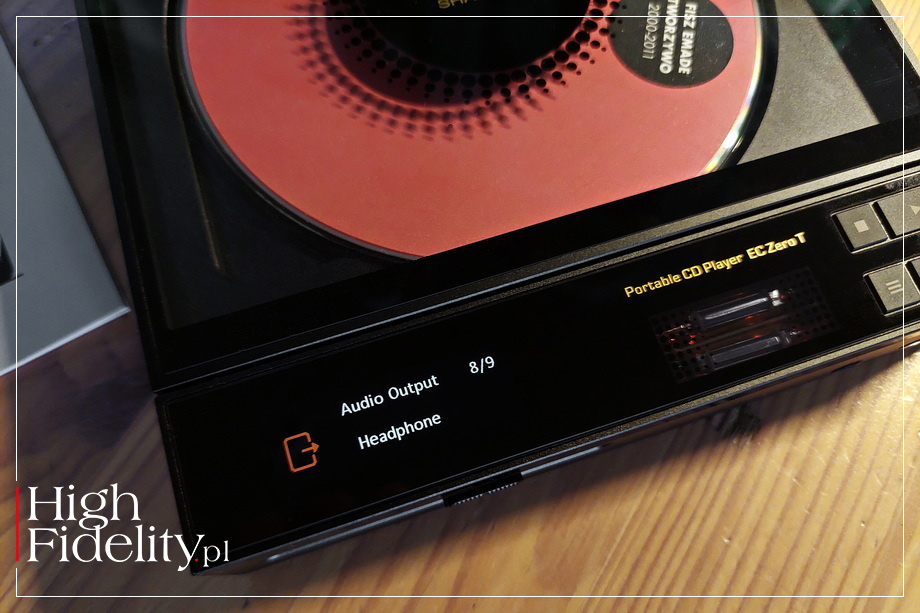
It so happened that a few days before I played the first album using the tested player, I was co-hosting a mini-concert by Tomasz Żółtko. According to Wikipedia, he is a “Polish singer, guitarist, composer, musician, poet, and journalist” and “creator of contemporary singer-songwriter music.” A medium-sized, but rather on the smaller side, Behringer digital mixing console, an AKG condenser microphone for vocals and guitar from the line output of the two effects he used – flanger and chorus. It couldn't be simpler. I monitored the sound through headphones Lime Ears Pneuma, which I also use at home to listen to music from portable players. Tomek's sound, that is, both his vocals and guitar, was strong, lively, and open. Above all, it had a strong attack. This was more pronounced than usual because the musician has such an expressive vocal and guitar technique – these are more “songs” than “tunes.” It only became calmer when he turned on both effects at once. I got a very similar effect listening to the greatest hits album by the duo FISZ EMADE TWORZYWO, Numer 1, featuring songs selected by the musicians from the years 2000-2011, a period heavily influenced by hip-hop. These are also quite raw, powerful, and engaging recordings, intended not only for radio playback, although that was the ultimate goal, I am sure, but also for ghetto blasters and other portable devices with speakers. And that's how it sounds. But this music also has a second layer when it comes to sound. It is very well-produced music, with clean sound, dynamic and well-organized. The tested Shanling showed these features very well. It is a resolving device, especially in the context of price and purpose, therefore it had no problems with delivering these recordings properly. It was also the case with the albums that the Waglewski brothers are probably listening to now that they are older, have families, children, in-laws, dogs, cats, etc. That is, with Frank Sinatra's Nice’n’Easy, John Scofield's Swallow Tales, or Bill Evans' new release entitled Haunted Heart: The Legendary Riverside Studio Recordings. 
This is not the warm and rich sound of the Shanling EC Smart or the S.M.S.L player – oh no! I keep listening, and conclude that it was chosen deliberately. How else can I explain the fact that when I play LED ZEPPELIN's IV, still in the 2004 version, an album I bought for pennies at Paul's Boutique Record Store in Krakow, where I sometimes dig up wonderful things from a pile of euro junk, paying fifteen, or sometimes twenty zlotys, that listening to it with the powerful, dynamic, fairly high sound of the player I was testing gave me goosebumps. It is a sound significantly different from what I am used to. But at the same time organized, clean, very “controlled” internally. That is, without audible distortion. I would even say that the higher range was better with it in terms of selectivity and attack than in both reference players. This was the case not only with in-ear monitors, which Lime Ears headphones essentially are, but also with Fosi Audio i5 magnetostatic headphones, aimed at perhaps not very wealthy but demanding music lovers. It really rocked, raced, and banged, if I may say so honestly. The remaster from before Jimmy Page's 2014 version emphasizes the live character of Zeppelin's albums, bringing out details, often at the expense of ‘meat’. It was clear. But it was also not emphasized to the point where it would become unpleasant. LANA DEL RAY’S album Ultraviolence, which I borrowed from my daughter, offered the same impressions. Her vocals had a bright part above 2-3 kHz, but without sharpness. This is a key feature of this device. It plays fast and accurately, but also with purity. It is this purity that “sets” its reception. Thanks to it, you can listen to music loudly and for a long time – a rare thing. The Grundig Discman my daughter uses is also cool because it is small, handy, and sounds nicely. But Shanling is from a different league, almost from another universe. It is an audiophile proposition for people who listen to Lana, Aurora, and K-pop rather than jazz lovers. More Radiohead and Ozzy Osbourne than Sinatra. 
And now – jazz also sounds great with it. It is usually recorded in a darker tone, so it fits in well with the sonic character of the device. Therefore, when talking about other musical styles, younger by about fifty or sixty years, I am not excluding the former. I am just saying that real “fun” comes with music that is meant for entertainment, that witnesses love affairs, drinking parties, events, group rivalries, etc. Bluetooth headphones also work well with this device. I have a feeling that the EC Zero T will be used with them just as often as with wired headphones. We lose some of the clarity and precision that we get with good wired headphones; I hope it is clear. But you can live with that and just enjoy a product that is perfectly made, fun to use, and attractive. When listening via cable, set the filters to NOS, turn on the output tubes, and enjoy! ● ▌ Technical specifications (acc to the manufacturer)
‖ General 
THIS TEST HAS BEEN DESIGNED ACCORDING TO THE GUIDELINES adopted by the Association of International Audiophile Publications, an international audio press association concerned with ethical and professional standards in our industry, of which HIGH FIDELITY is a founding member. More about the association and its constituent titles → HERE. |
 |







|
Reference system 2026 |
|
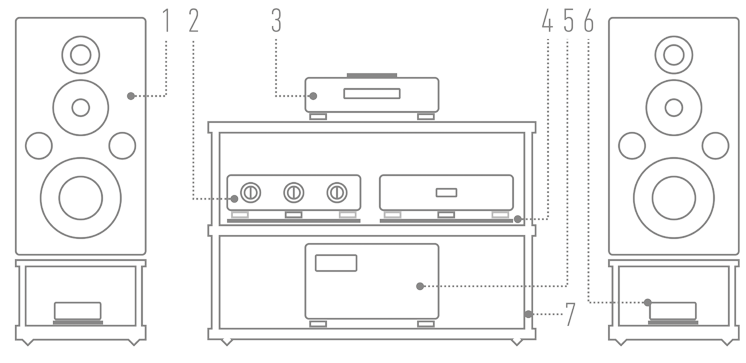 1) Loudspeakers: HARBETH M40.1 |REVIEW| 2) Line preamplifier: AYON AUDIO Spheris III Linestage |REVIEW| 3) Super Audio CD Player: AYON AUDIO CD-35 HF Edition No. 01/50 |REVIEW| 4) Stands (loudspeakers): ACOUSTIC REVIVE (custom) |ABOUT| 5) Power amplifier: SOULUTION 710 6) Loudspeaker filter: SPEC REAL-SOUND PROCESSOR RSP-AZ9EX (prototype) |REVIEW| 7) Hi-Fi rack: Hi-Fi rack: finite elemente MASTER REFERENCE PAGODE EDITION Mk II, more → HERE |
|

|
Cables Analog interconnect SACD Player - Line preamplifier: SILTECH Triple Crown (1 m) |ABOUT|» ANALOG INTERCONNECT Line preamplifier → Power amplifier: Siltech ROYAL SINLGE CROWN RCA; review → HERE Speaker cable: SILTECH Triple Crown (2.5 m) |ABOUT| |

|
AC Power Power cable | Mains Power Distribution Block - SACD Player: SILTECH Triple CrownPower (2 m) |ARTICLE| » POWER CABLE Mains Power Distribution Block → Line preamplifier: Acoustic Revive ABSOLUTE-POWER CORD, review → HERE » POWER CABLE Mains Power Distribution Block → Power amplifier: Acoustic Revive ABSOLUTE-POWER CORD, review → HERE Power cable | Power Receptacle - Mains Power Distribution Block: ACROLINK Mexcel 7N-PC9500 (2 m) |ARTICLE| Power Receptacle: Acoustic Revive RTP-4eu ULTIMATE |REVIEW| » ANTI-VIBRATION PLATFORM under Acoustic Revive RTP-4eu ULTIMATE: Graphite Audio CLASSIC 100 ULTRA, review → HERE Power Supply Conditioner: Acoustic Revive RPC-1 |REVIEW| Power Supply Conditioner: Acoustic Revive RAS-14 Triple-C |REVIEW| Passive filter EMI/RFI: VERICTUM Block |REVIEW| |

|
Anti-vibration Speaker stands: ACOUSTIC REVIVE (custom)Hi-Fi rack: finite elemente MASTER REFERENCE PAGODE EDITION Mk II, more → HERE Anti-vibration platforms: ACOUSTIC REVIVE RAF-48H |ARTICLE| » ANTI-VIBRATIONAL FEET: |

|
Analogue Phono preamplifier: Phono cartridges:
Clamp: PATHE WINGS Titanium PW-Ti 770 | Limited Edition Record mats:
|

|
Headphones » HEADPHONE AMPLIFIER: Leben CS-600X, review → HEREHeadphones: Headphone Cables: Forza AudioWorks NOIR HYBRID HPC |