


|
INTEGRATED AMPLIFIER CIRCLE LABS
Manufacturer: CIRCLE LABS |

 |
 |
 |
|
Review
text by WOJCIECH PACUŁA |

|
No 261 February 1, 2026 |
|
˻ PREMIERE REVIEW ˼
IT WASN'T SUPPOSED TO BE... Not that anyone wanted to erase it, but in the sense that if it weren't for an outsider, perhaps no one would have thought that a product like the AS100 was missing from the lineup. Recently, the range of products offered by this still young company has expanded upwards with new, more expensive products. 
The first ever device in our lineup was the A100 integrated amplifier. However, it is the A200 from 2020, which we tested in September of the same year, that seemed to be the company’s “proper” debut; more → HERE. A year later, Circle Labs introduced a set consisting of the P300 preamplifier and M200 power amplifier, which we tested → HERE. Marek Dyba tested the same system, but with two M200s operating as monoblocks; more → HERE. It was an important year for the company. As Mr. Wilczyński told us at the time, it was a “breakthrough” for them:
We currently sell our products in Poland, the USA, Spain, Portugal, Thailand, Russia, Lithuania, and England, and we are finalizing talks with Hungary, Germany, and Australia. We'll see what happens next... We don't want to become a big factory; we don't have such aspirations. We want to remain a “boutique” manufacturer for whom quality is of paramount importance. » HF № 212
Later, the growth of the company slowed down due to both COVID 19-related problems and the increasingly limited availability of integrated circuits and semiconductors. That is why the September 2024 announcement of the V1000 phono preamplifier, which we tested in January 2025, was met with such great interest; more → HERE. Also in September, but in 2025, we received information about two new devices to be introduced: the top-of-the-line M500 power amplifier and the subject of this test, the AS100 integrated amplifier. As it happens, the latter owes a lot to the solutions – both systemic and technological – developed for the M500. It brings two fundamental changes: a semiconductor preamplifier and a proprietary signal attenuator. ▲ A few simple words… KRZYSZTOF LICHOŃ 
⸜ Proprietary resistor ladder, switched by Omron relays The idea for the AS100 amplifier was born during intensive work on our new flagship power amplifiers. For over three years, we strove to create a design that was significantly larger, more powerful, and even better than the world-renowned and beloved M200 power amplifiers. It was a demanding process, full of experiments and long listening sessions — the project matured slowly but steadily. During this work, dozens of prototypes of the future flagship M500 were created. One of them turned out to be special — instead of a tube voltage amplification stage, we used a modified semiconductor circuit from the Circle Labs P300 line preamplifier. This is how the working version, called S500, was developed. 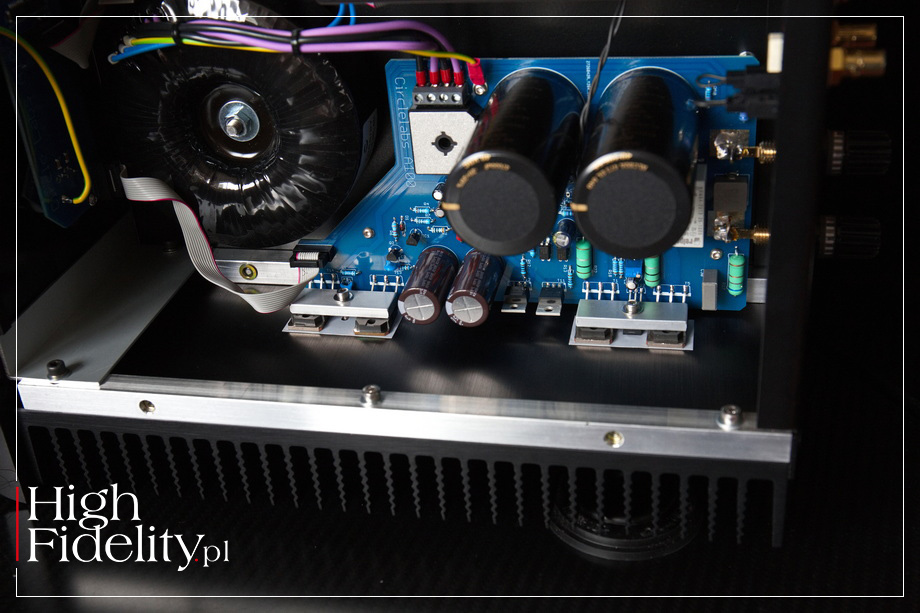
⸜ The output transistors, two push-pull pairs per channel During one of the listening sessions, we were visited by Grzegorz Wyka from Nautilus. After a moment of silence, concentration, and careful listening, he said: “You've made a disturbingly good amplifier.” It was then that Grzegorz had an idea, which he somewhat pushed on us and which changed the course of the project: now his main goal was to develop a new Circle Labs integrated amplifier based on this concept, available at a price of around twenty thousand zlotys. Initially, we approached this idea reluctantly. However, Krzysiek Wilczyński decided to check how this circuit would sound in a lower-power version, with a new volume control developed by us from scratch, enclosed in a more compact chassis, while maintaining the same topology and uncompromising quality of components. 
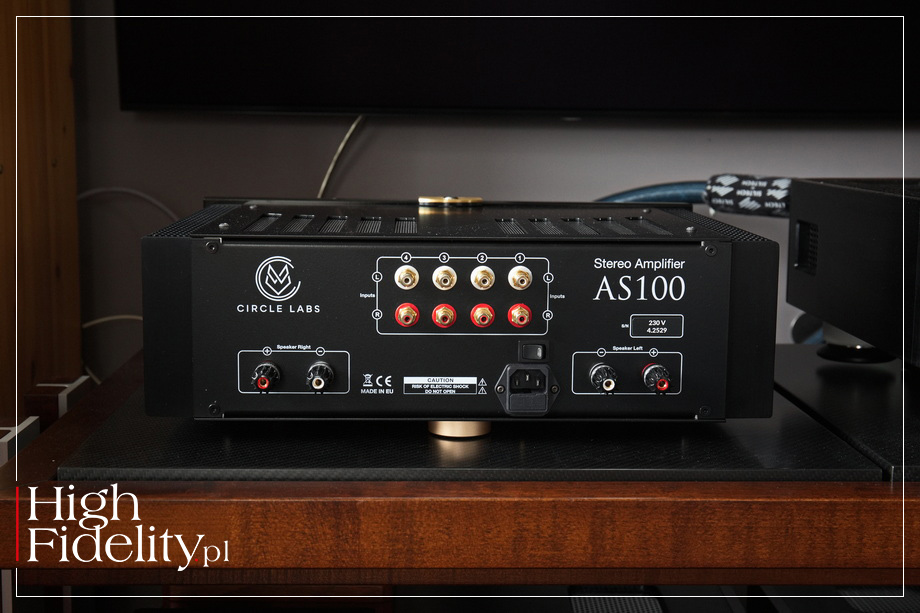
⸜ An important part of the power supply is the high-quality capacitors from Kemet (currently part of Yageo Corporation). The result exceeded our expectations. It turned out that with a well-thought-out design, it is possible to create an amplifier that combines high-end ambitions with real affordability. This is how the AS100 came to be – an amplifier whose godfather was Grzegorz Wyka, and which today is one of the most important products in our offer. »KL ▌ AS100 FEATURES • The AS100 is an integrated amplifier. You could even call it a “classic integrated amplifier.” That is, one that is used solely to amplify line signals. The device features four RCA line inputs and an output power of 65 W at 8 Ω and 110 W at 4 Ω. 
There is no digital-to-analog converter, Bluetooth connectivity, or even a phono preamplifier; there is also no headphone amplifier. It would be nice to have all that, right? Big companies from China will give it to us, that's life. However, CL is a tiny manufacturer, focused on the basics, and each such addition also means a higher final price. So, as usual, it’s a give some and take some situation, i.e., minimalism for the handiwork of local designers and craftsmen who are available and within reach. Circe Labs products share a distinctive, stunning design. What's more, it's well thought out and has stood the test of time. It is still attractive and simply interesting. The AS100 looks the same as the company's more expensive products, with nothing lacking in this respect. The front panel is made of glass rather than acrylic, similar to McIntosh devices, to mention the most obvious point of reference. The connectors are also top-of-the-line – the large gold-plated RCA sockets are sourced from the Taiwanese company CMC (Charming Music Conductor), and the speaker terminals of gold-plated copper are made in China. Krzysztof Lichoń, head of the KOOBA Creative Agency and responsible for the project, assumed that the amplifiers should look “the same in a year and in ten years.” As he once told us, he wanted to use a classy material that would give depth, color, and reflections that are not possible with “plexiglass.” The front panels are therefore handmade by master craftsmen, which makes them unique. The consistency of the looks of all the company's devices is also ensured by screen printing on a black background and brass elements, such as the standby button, which, together with the cooling holes on the top panel covered with a metal mesh, takes us back to the 1930s and the radio receivers of that period. The device stands on three brass feet – two at the front and one at the back, which also gives it a stylish look. TECHNOLOGY • The AS100 circuit is built in a dual mono topology, with separate power supplies for each channel, and has the following block configuration: input selector → relay volume control → preamplifier → power amplifier. All the circuits used by the company were conceived by its founder, Krzysztof Wilczyński. Technological changes in production, such as finding external subcontractors to manufacture and assemble circuit boards, streamlining the assembly process, etc., are also his achievements and the result of his intensive work in recent years. It should be added that Jacek Kopczyński, M.Sc., Eng., from the Kraków University of Technology, a consultant for the company's ideas, played an important role in the company's development. Although these are important adjustments, the user does not see them. The same applies to the most important change compared to the company's previous devices. Instead of an E88CC tube input stage, the AS100 uses a transistor-based preamplifier, and the signal is attenuated in a proprietary attenuator. The signal first goes to a relay resistor ladder designed by Circle Labs, equipped with a remote control. The ladder resistors are switched using hermetic Omron signal relays. The preamplifier, located behind the volume control, is entirely solid-state. The latest J-FET transistors Burr-Brown JFE2140 and bipolar transistors are used in the input stage. The preamplifier uses a separate power transformer and stabilization. 
The power amplifiers produced by this company are built using a proprietary circuit called Circle Power, where a JFET transistor is used at the input and bipolar transistors at the output. Developed in 2013, this amplifier circuit is, as Mr. Wilczyński says, “as simple as a circle,” hence the name. The AS 100 power amplifier also uses the Circle Power topology, but in its latest version. It adds voltage stabilization for the preamplifier stage and uses Burr-Brown JFE150 J-FET transistors at the input. The output stage, in turn, uses a pair of Sanken 2SA1294 + 2SC3263 transistors, controlled by Sanken 2SA1694 transistors. The power supply uses two toroidal transformers with a power rating of 200 W each, as well as Kemet capacitors with a total capacity of nearly 190,000 µF (2 × 47,000 µF per channel). It all looks great. ▌ SOUND HOW WE LISTENED • The AS100 integrated amplifier was assessed in the HIGH FIDELITY reference system. It was compared to a set consisting of an AYON AUDIO SPHERIS EVO preamplifier and a SOULUTION 710 power amplifier. 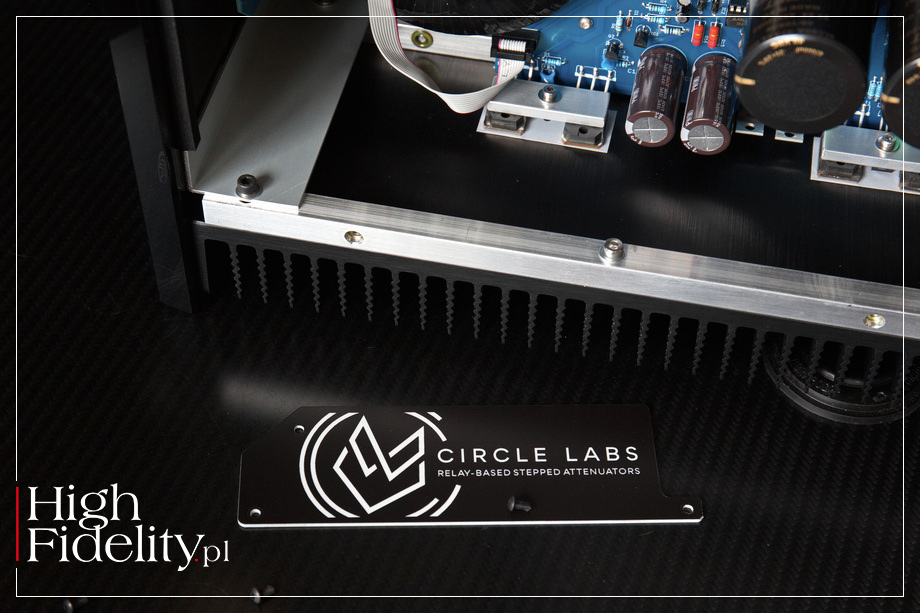
The AS100 was placed on the top (carbon) shelf of the Finite Elemente Master Reference Pagode Edition MkII rack. The following devices were used a sources: (1) the AYON AUDIO CD-35 HF EDITION SACD player via the SILTECH TRIPLE CROWN RCA interconnect and (2) the SFORZATO DSP-05EX file player with the PMC-05EX clock via the SILTECH SINGLE CROWN RCA interconnect. The tested amplifier was powered using an ACROLINK MEXCEL 7N-PC9100 cable. It drove HARBETH M40.1 speakers using CRYSTAL CABLE ART SERIES DA VINCI cables. Let me add that I also used SPEC RSP-901EX speaker filters, described by the manufacturer as “Real-Sound Processors.” 
» RECORDINGS USED FOR THE TEST ⸜ a selection
• THOMAS KESSLER, Infinite Sky, Hypersensitive Records HRCS 005, Limited Edition CD-R 2023. I WONDER WHAT YOU THOUGHT about when you read that Circle Labs' latest amplifier no longer uses tubes in its circuitry, but is now fully solid-state. I would like to peek inside your heads and see how the wheels of association turn, how the habits and stereotypes click into place and initiate your beliefs. But even without such insight, I am almost certain that it went something like this: “Vacuum tubes = warmth, transistors = sterility, meaning: AS100 = mechanical sounding.” Nothing could be further from the truth. |
This amplifier offers a wide tonal palette. It is also a device that builds music with delicate strokes, with a pearly sheen, but smoothly and in a rounded way. In the sense that there is no aggression in the presentation. And although its performance is open and agile, it’s not based on attack. There is no feeling of being forced into anything. And although the album I started this listening session with, the wonderful Thomas Kessler’s Infinite Sky, which is vivid and calm in itself, the AS100 did not rush it. It was melancholic, and calm presentation, but also internally charged with emotion. The latest integrated amplifier from the Nowa Huta-based company shows the better side of the world. That is, so as not to overwhelm us with an abundance of detail. I listened to Ella Fitzgerald's Ella Wishes You a Swinging Christmas for a long time, because I happened to listen to it just before Christmas, but also because it sounded so good. The amplifier is not dispassionate in its behavior and modifies the sound towards a “warmer” sound. However, it does not warm anything up, its sound is open. Rather, it rounds off the attack, which allows Fitzgerald's brightly recorded vocals to sound really good and listener-friendly.
Her voice is recorded quite clearly, with the low midrange cut out. Interestingly, reviews describe her vocals as “warm and engaging.” Listen for yourselves and see what you think. The AS100 didn't complement Fitzgerald's voice. But it did something that made not only the intimate ˻ 4 ˺ What Are You Doing New Year’s Eve?, but also the dynamic ˻ 2 ˺ Santa Claus Is Coming To Town sounded lively – ah, that choir spread across the channels! – but also fluid. The vocals were closer to me than with the reference amplifier, as was the entire sound. This is a device that offers rather intimate than distanced experience. This intimacy is not shallow, if you know what I mean. What I mean is that I got a full-blooded recreation of the studio situation, thanks to which the fantastic remaster of Breakout's NOL album, that Damian Lipiński deserves applause for, sounded really well. Once again, the vocals were placed close to me, closer than with the reference amplifier, and there wasn’t as much reverberation around them. But the whole thing was dynamic and energetic, as if on a booster. ▲ Our albums MIE JOKÉ Bonheur Ultra Art Record UA-1008 ⸜ 2025 
THEBonheur, subtitled 10 Songs for your Next Day, is jazz singer Mie Joké's third album recorded for Ultra Art Record. Joké-san, born in Uwajima, Ehime, fell in love with music under the influence of her father. At the age of six, she began playing the piano and became interested in singing. After falling in love with the sound of Ella Fitzgerald's voice, she began performing in jazz clubs herself. After graduating from college, she moved to Tokyo, where she got a job as a waitress at the renowned jazz club Body & Soul in Minami Aoyama. She soon made her stage debut based on the recommendation from the club's owner, Kyoko Seki. She recorded a live concert with renowned pianist Tsuyoshi Yamamoto and began her career as a professional singer, which she continued for three years before suddenly giving up her career. In 2008, she decided to try again and studied singing under the guidance of vocalist Kimiko Ito. In February 2009, she successfully auditioned at the Yoyogi Naru club and returned to the stage. She currently sings at jazz clubs, performing monthly at Body & Soul (Minami Aoyama), Yoyogi NARU in Tokyo, and throughout the country. 
We wrote about Ultra Art Records, co-founded by REIJI ASAKURA and lead by HARUO USHIO, in 2021; more → HERE. It is one of those labels with a small catalog, but each title is quite an event for it. It offers LPs, SACDs, and CDs. The former are not offered only in the classic format, but also in the form of 12“ 78 rpm maxi singles (!). The CDs, on the other hand, are not ‘regular’ discs. The latest one combines three technologies: UHQCD (Ultimate Hi-Quality CD), MQA encoding (MQA-CD), and turquoise lacquer, used for Platinum SHM-CD and SHM-SACD discs. This is another label that has reached for MQA, comparing this type of encoding to master tape and hi-res files. 
The album was recorded in both, analog (for LP) and digital in hi-res files (for (CD) forms at Pony Canyon Yoyogi Studio, with tracks recorded in one take, without editing, to – as we read – “maximize the jazz groove.” The sound engineer responsible for the album is the renowned Toshiyasu Shiozawa (Nippon Columbia), a 22-time winner of the Professional Recording Award. Kumiko Yamashita (Nippon Columbia) was the mastering engineer. The album was officially released on September 10, 2025, and is also set to be released on vinyl. The sound of this album is very direct, open, and “raw.” In the sense that it is not heavily produced. There is a lot of sibilants in the singer's voice, sustained using a bright reverb, and this is what opens up her sound the most. So it's not your typical “bedroom” smooth jazz, but rather something like watching a rehearsal before a performance. The double bass’ attack is emphasized, which gives it clarity and control over the tone. The space is not particularly inflated. The idea was rather to show the instruments in their natural environment, quite close to each other and in perspective, without any special effects that would “embed” them in the sound. And yes, the MQA-CD player shows more of the upper range, which is more resolving. But even standard players “sink” into this “here and now” sound, shown without makeup and lipstick, and only with a slight afterimage of Channel № 5 perfume. 
˻ BIG RED BUTTON ˺ ● from us. THE AMPLIFIER perfectly controls low frequencies, because the drum beat in the opening track ˻ 1 ˺ Taki wiatr was clear and dynamic. The guitar and Fender Rhodes organ, positioned at the far right and left, respectively, had weight and heft. But above all, they were lively. The same goes for the cymbals. They are perfectly recorded on this album, unlike on most Polish albums. With Circle Labs, their uniqueness was clear, as was the fact that the microphones used to record them were not high-end enough to convey their weight. But the dynamics and sonority were perfect. 
You can hear how they can sound on a rock album by listening to ˻ 1 ˺ Synchronicity, the opening track of The Police's album of the same title. The AS100 played them perfectly, clearly, and powerfully, but also with distance. In addition, it did not dampen the brightness the album was recorded with and presented with in the latest remaster from 2024. It was a blast, but unfortunately, it is not a tonally balanced sound (NOL is a unique album in this respect), and the Polish amplifier did not cover it up. And yet it sounded just right. The fact is that Circle Labs' new, fully solid-state amplifier sounds smoother than its hybrid siblings. That's why I started this article with an imaginary visit into the heads of High Fidelity readers. Stereotypes are fun, but they need to be verified. Especially in audio. Although you will find people online who are ready to swear that one technology or another is the best and the rest should be discarded, this is not the case. Just as much depends on its implementation, and our perfectionist industry has room for many solutions that are equivalent in terms of class. And we could end this test here, were it not for the fact that the Polish amplifier is not a typical MOSFET device, i.e., warm and sweet. Krzysztof Wilczyński designs his devices with the idea (if I understand it correctly) that they should be as tonally well-balanced as possible. This also applies to the AS100. So it is not a stereotypically “warm” sound, as I mentioned earlier. Nor is it bright. It is well-balanced and therefore very versatile. However, when we take a closer look, what I am talking about becomes clear: it is a friendly and pleasant sound. 
Yes, the brightness of The Police's album remained so, but it was somehow less annoying. The open treble gave the cymbals a resonant sound, but did not brighten the vocals. Also, JANIS IAN's voice in the ˻ 2 ˺ At Seventeen, a track from the Between The Lines, was strong, almost warm, but also slightly distant and with clearly audible sibilants. These are necessary in sound because they are part of the voice. But when exaggerated, they are the bane of audio. And the amplifier in the test balanced all of that nicely. ▌ Summary BECAUSE THAT'S HOW IT IS, a very nice-sounding device. It can extend the bass nicely and still control it. It worked fantastically with the deep electronic notes in ˻ 9 ˺ Tako Tsubo by the English band L'IMPÉRATRICE. The AS100 will also deliver strong, clear treble, but it will lead those high notes towards a slight rounding, as it does with the upper midrange. It offers a direct, close sound, which makes everything seem tangible, almost within reach, as in ˻ 2 ˺ August Day Song, a track from the album by BEBEL GILBERTO (João Gilberto's daughter). 
Everything in this sound is well-organized and kept under control. There is also room for madness, but it is a ‘licensed madness’. So, within certain limits. On the one hand, the sound is open and lively, and on the other, it is somehow internally beautiful. Neither warm nor cold, but balanced. With its fantastic design and very good workmanship, we get a complete, competent product with few competitors in this price range. One can build a high-class audio system around it. A system with soul and nerve. Therefore, form us a deserved ˻ RED FINGERPRINT ˺. ● ▌ Technical specifications (acc. to the manufacturer)
Inputs: 4 x RCA 
THIS TEST HAS BEEN DESIGNED ACCORDING TO THE GUIDELINES adopted by the Association of International Audiophile Publications, an international audio press association concerned with ethical and professional standards in our industry, of which HIGH FIDELITY is a founding member. More about the association and its constituent titles → HERE. |
 |
|
Reference system 2026 |
|
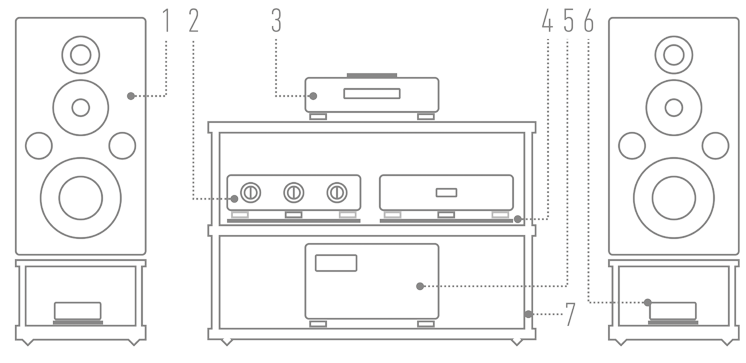 1) Loudspeakers: HARBETH M40.1 |REVIEW| 2) Line preamplifier: AYON AUDIO Spheris III Linestage |REVIEW| 3) Super Audio CD Player: AYON AUDIO CD-35 HF Edition No. 01/50 |REVIEW| 4) Stands (loudspeakers): ACOUSTIC REVIVE (custom) |ABOUT| 5) Power amplifier: SOULUTION 710 6) Loudspeaker filter: SPEC REAL-SOUND PROCESSOR RSP-AZ9EX (prototype) |REVIEW| 7) Hi-Fi rack: Hi-Fi rack: finite elemente MASTER REFERENCE PAGODE EDITION Mk II, more → HERE |
|

|
Cables Analog interconnect SACD Player - Line preamplifier: SILTECH Triple Crown (1 m) |ABOUT|» ANALOG INTERCONNECT Line preamplifier → Power amplifier: Siltech ROYAL SINLGE CROWN RCA; review → HERE Speaker cable: SILTECH Triple Crown (2.5 m) |ABOUT| |

|
AC Power Power cable | Mains Power Distribution Block - SACD Player: SILTECH Triple CrownPower (2 m) |ARTICLE| » POWER CABLE Mains Power Distribution Block → Line preamplifier: Acoustic Revive ABSOLUTE-POWER CORD, review → HERE » POWER CABLE Mains Power Distribution Block → Power amplifier: Acoustic Revive ABSOLUTE-POWER CORD, review → HERE Power cable | Power Receptacle - Mains Power Distribution Block: ACROLINK Mexcel 7N-PC9500 (2 m) |ARTICLE| Power Receptacle: Acoustic Revive RTP-4eu ULTIMATE |REVIEW| » ANTI-VIBRATION PLATFORM under Acoustic Revive RTP-4eu ULTIMATE: Graphite Audio CLASSIC 100 ULTRA, review → HERE Power Supply Conditioner: Acoustic Revive RPC-1 |REVIEW| Power Supply Conditioner: Acoustic Revive RAS-14 Triple-C |REVIEW| Passive filter EMI/RFI: VERICTUM Block |REVIEW| |

|
Anti-vibration Speaker stands: ACOUSTIC REVIVE (custom)Hi-Fi rack: finite elemente MASTER REFERENCE PAGODE EDITION Mk II, more → HERE Anti-vibration platforms: ACOUSTIC REVIVE RAF-48H |ARTICLE| » ANTI-VIBRATIONAL FEET: |

|
Analogue Phono preamplifier: Phono cartridges:
Clamp: PATHE WINGS Titanium PW-Ti 770 | Limited Edition Record mats:
|

|
Headphones » HEADPHONE AMPLIFIER: Leben CS-600X, review → HEREHeadphones: Headphone Cables: Forza AudioWorks NOIR HYBRID HPC |