


|
POWER AMPLIFIER • stereo BOULDER
Manufacturer: BOULDER AMPLIFIERS |

 |
 |
 |
 |
|
Review
text by MAREK DYBA |

|
No 263 April 1, 2026 |
WHAT IS BOULDER LIKE? One might be tempted to say, “It’s for anyone to see.” First, because the design of all the brand’s devices is distinctive and therefore easily recognizable– and, moreover, consistent (apart from minor details). Second, because it is unique, refined, and highly appreciated by users; therefore, the American manufacturer has no reason to change it. 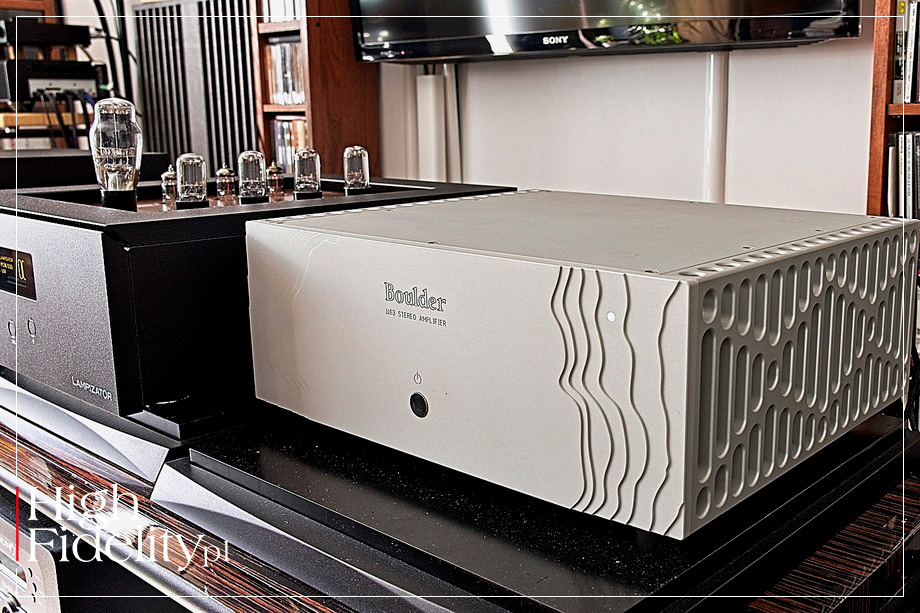
Only the more affordable devices from the 800 Series– and, in fact, the very most affordable phono preamp from the 500 Series – differ quite noticeably, though even they retain certain common features with Boulder’s larger and more expensive components. The manufacturer itself emphasizes that it is “the last high-end audio manufacturer in North America that still designs, develops, and manufactures its products in-house.” New products are introduced not very often and fit perfectly into the company’s standards and philosophy. So when a new model is finally unveiled, the only visible clue is usually a number engraved in small digits on its front panel, which is also the case with the 1163. For the record, let's note that the 1100 series currently includes five devices: two preamplifiers (a line preamp and a phono preamp), monaural, and two stereo power amplifiers. The latter set this line apart from the two more expensive ones. At the “budget” (by Boulder standards) level, the manufacturer offers potential customers two options: the mighty 1162 amplifier (weighing a “mere” 61 kg) capable of delivering (at 8 Ω) continuous power of up to 300 W (450 W at peak), or its significantly smaller sibling, the 1163 that we are reviewing. The former, the 1162, replaced the 1160 in the lineup, which I once had the pleasure of testing alongside the company’s line-level preamplifier; more → HERE ˻PL˺. The amplifier under review, the 1163, in turn, replaced the 1161; more → HERE ˻PL˺. The new power amplifiers are aimed at the same – or rather, those with similar requirements – customers. The larger (both physically and in terms of maximum output) 1162 is intended for owners of more demanding speakers or exceptionally large listening rooms – in short, for those who need a lot of power. On the other hand, audiophiles whose rooms are not that huge and whose speakers are less demanding should be happy with the smaller and, which may be a pretty important factor, significantly less expensive 1163. Mind you, realistically speaking, 150 W at 8 Ω is enough to drive – I’m just guessing here, but I probably am not too far off– at least 95% of the speakers available on the market in any normal room. I won’t even mention that the latter weighs a modest 25 kg instead of 62, and needs much less space; though for some, that too might be a reason to choose it over the bigger and heavier 1162. All the more so since the manufacturer assures us of an equally uncompromising approach to the design and construction of both (and, in fact, all of its) devices. The choice should therefore be based primarily on power requirements, which are a function of how easy or difficult your speakers are to drive, the size (and acoustics) of the listening room you plan to use the setup in, and possibly some individual preferences. ▓ 1163 AS I MENTIONED at the beginning, the design of Boulder’s amplifiers (and other products) has remained virtually unchanged for many years. Color: silver; “strange” lines on the front panel– those familiar with the brand know these are contour lines, i.e., lines on a topographic map connecting points at the same elevation above sea level – depicting the topography of the Boulder area, specifically Flagstaff Mountain; fantastically crafted heat sinks serving as side panels; distinctive speaker terminals with large wing nuts that accept only spade plugs; exclusively balanced line inputs; and the build quality and finish: perfect - that sums it up nicely. SOMETHING SPECIAL • In the company’s more expensive and powerful amplifier models, another distinctive or ‘special’ feature is the 32-amp AC power socket, which requires special cables terminated with appropriate plugs. However, since the 1163 belongs to the family of “low-power” amplifiers – that is, those with “low” output by this brand’s standards – and thus does not share power requirements with an industrial welder, a standard power cord with an IEC plug suffices. Next to the inlet on the rear panel, you will find the amplifier’s main power switch and fuse. There is nothing special about the chassis of the reviewed amplifier because, since it represents the Boulder brand, one expects it to be exceptionally well-built, and so it is. It is constructed from thick sheets of aluminum, and the entire design is engineered to dampen unwanted vibrations as much as possible. The whole unit rests on four anti-vibration feet. On the front panel, in addition to the aforementioned engraved map of Flagstaff Mountain and the brand and model names, there is a metal power switch and a single power LED. The latter, which I keep repeating in seemingly every Boulder review with a persistence worthy of a better cause, is (for me!) highly irritating. You see, when the device is in standby mode, the bright white LED slowly flashes all the time. After powering the device on, during the startup procedure, it continues to flash but alternates between white and red. Finally, when the device is ready for use, the white LED glows steadily, again with quite high intensity. If you fall in love with this amplifier and the LED irritates you as much as it does me, especially during evening listening sessions, you can always stick a piece of tape on it. That’s how high-tech meets real life. SOMETHING CLASSIC • Another thing that has remained constant over the years is the uncompromising approach of Boulder’s engineers– led by Jeff Nelson, the brand’s founder – to the design of every device and their unwavering preference for fully balanced connections and circuits. This applies even to the most affordable series, including the 508 phono preamp. In short, the preamplifier (unless it’s a Boulder model) or a source with an adjustable output level must feature balanced outputs, preferably “genuine” ones. In previous reviews of this company’s equipment, this was a problem for me. So I swapped out the LampizatOr Pacific DAC for a balanced model from the same brand, the Poseidon (to be clear, not just for the sake of Boulder, but there are other brands that prefer balanced connections as well). As the manufacturer itself suggests, you can use cables terminated on one end with RCA plugs and on the other with XLR connectors, but it will compromise performance to a point; I won’t even mention the availability of such cables. So if you decide on an amplifier from this brand, it’s best to consider a fully balanced signal path. On the rear panel, in addition to the already mentioned speaker spade-only terminals, AC power input, and XLR line inputs, you will find LAN and USB ports. For older models, the manufacturer suggested that the former could be used to integrate the amplifier into a smart home system. I didn’t find a single word about this feature in the 1163 manual. However, it does mention that the Ethernet port should be connected to your home network to allow for amplifier firmware updates, if made available. Updates can also be performed via the USB port. 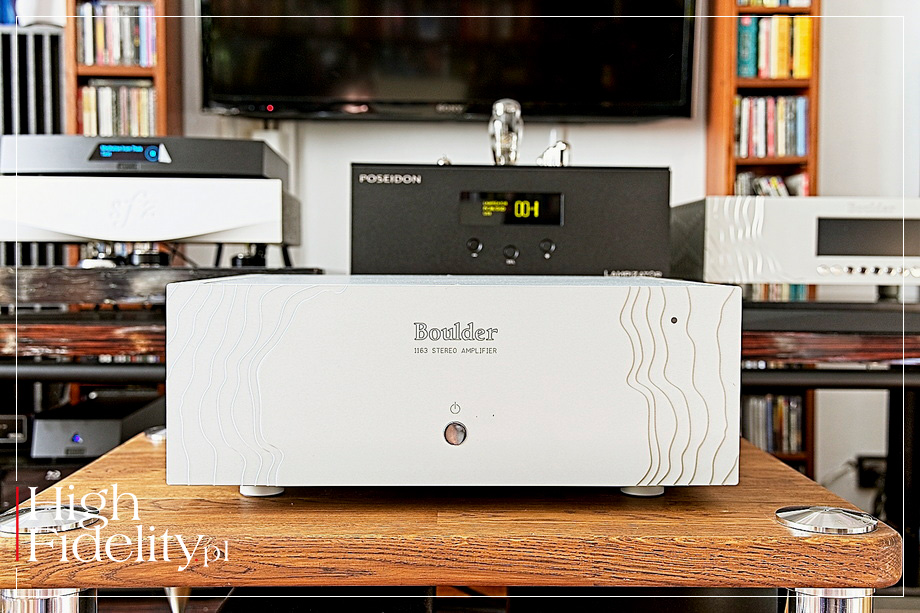
SOMETHING ESSENTIAL • As you can see, from the outside, it is difficult to distinguish the 1163 from its predecessor, and even when looking at the specifications, the differences appear mainly in the second or even third decimal place of some parameters. Nevertheless, as the manufacturer assures us, the differences are in fact significant, though only visible inside the device. As stated in the documentation for this model, Boulder’s engineers drew on solutions developed for the 1151 monoblocks when designing it. This means, for example, the use of a special, modernized, and redesigned automatic bias circuit (“Class A Bias scheme”), which precisely stabilizes the bias current, eliminating the need for manual calibration. Another key solution is the Smart Current Output Stage. The amplifier delivers the first (presumably, as the manufacturer does not specify this) dozen or so watts in Class A and only switches to Class AB when the demand for power is higher. At 8 Ω, it can deliver up to 150 W continuously per channel. The ‘intelligence’ of this circuit lies in adjusting the current/power supply depending on the current demand of the driven speakers. In this way, not only is power consumption reduced – including heat loss – but the amplifier’s lifespan is also extended, as it operates at lower temperatures than typical for Class A devices. It should be noted that the 1163 output stage utilizes as many as forty transistors, supported by a bank of twelve filtering capacitors, which is designed to ensure stable operation even under high power demands and with any load. Another characteristic of the brand is its extremely low output impedance, which is designed to ensure the amplifier’s sound remains consistent regardless of the speakers connected to it, even if they have significant impedance drops. All printed circuit boards used in the 1163 have been modified and improved compared to the 1161 model. The robust toroidal transformer responsible for the power supply is enclosed in a solidly shielded housing and damped by filling it with resin. The amplifier cover was also damped during the assembly of the housing. The tested power amplifier also utilizes the proprietary 985 gain stage, exactly the same as the one used in the larger 1162 model. The device is also equipped with a newly developed protection circuit, which is designed to safely and immediately shut down the output stage in the event of a short circuit in the speaker cables or system malfunctions. ▓ SOUND HOW WE LISTENED • For the main part of the test, my balanced LampizatOr Poseidon D/A Converter served as the primary source, fed with the signal from my custom server (and later also from the Lumin U2X) via David Laboga’s top-of-the-line USB cable, the Akoya. Since the Polish DAC features excellent volume control, I used it both to directly control the Boulder and in combination with the Circle Labs P300 balanced line preamplifier. 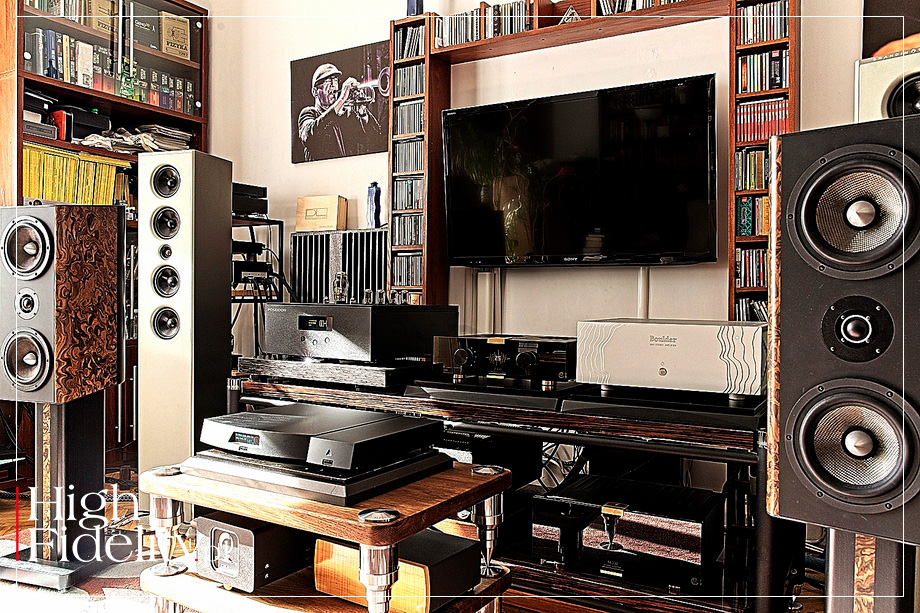
In the first setup, I connected the LampizatOr to the power amplifier using a Next Level Tech Ether balanced interconnect. In the second setup, the same cable connected the DAC to the preamplifier, and from there the signal traveled via another balanced interconnect, the KBL Sound Himalaya 2. Toward the end of the listening sessions, I also received Boulder’s own preamp, the Model 1110, which briefly replaced the Circle Labs unit. Although this wasn’t quite “kosher” – according to Boulder, which recognizes only balanced connections – for the test, I also used a J.Sikora Standard Max turntable with the company’s tonearms (KV12 Max and KV9) and Air Tight PC-3 and LeSon LS10 Mk II cartridges. The GrandiNote Celio Mk IV phono preamp (and later the new LampizatOr VP-Lite MC Silver) was connected to the preamp’s RCA input via a Bastanis Imperial interconnect. 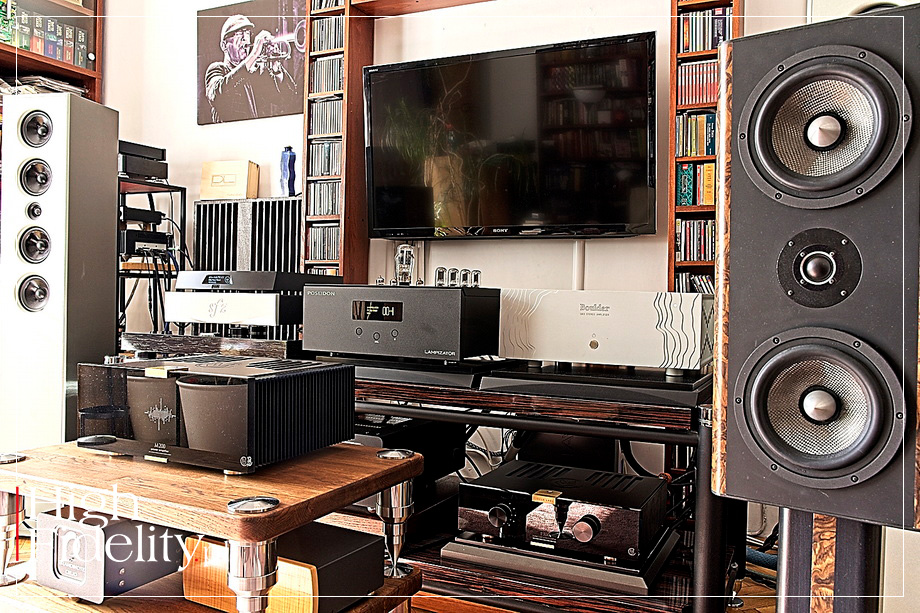
The tested power amplifier, connected using WK Audio TheRAY speaker cables (mine are terminated with spades on the amplifier’s side), drove my GrandiNote MACH4 speakers, but I couldn’t help myself, and optionally, I had to use the fantastic (!!!) latest iteration of Tomek Kursa’s speakers, the AudioForm M200. The latter, following modifications to the crossover, have (in my opinion) risen to the elite ranks of the top tier of bookshelf speakers. Sorry for the digression, but I love to praise Polish products, and this one is outstanding! The amplifiers were powered directly from Furutech wall outlets (on a separate line to the junction box), and the rest of the equipment from the Gigawatt PC-3 SE EVO+ conditioner. All electronics, except for the phono preamp and turntable, were placed on the Base VI rack. The analog setup has been running on the Rogoz Audio 3RP3/BBS rack for years. I SAY THIS OVER AND OVER AGAIN, but I feel I have to. Comparing devices that were listened to several years apart isn’t entirely reliable, even if you have notes or the final version of a review of the older device at your disposal. So, when comparing the 1163 to the 1160 or 1161 (which I tested), I can write more about “what I think or believe” than about an unshakable confidence in my assessment, which could be possible if I placed them all side by side and listened to them one after another. 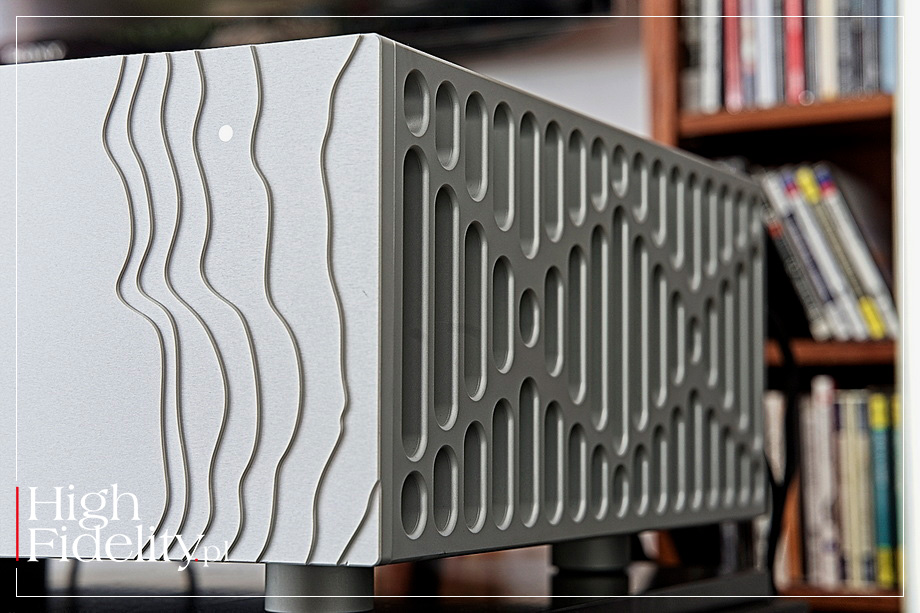
It seems to me, then, that the 1163 fits into a certain trend that has been almost ubiquitous in the world of solid-state amplifiers in recent years, namely, instead of focusing on hyper-detailed, super-transparent, super-precise, and cold, analytical sound, these newer transistors, including the tested Boulder, shift the emphasis toward natural, full sound with great flow. |
Perhaps they don’t so much shift the emphasis as they allow these particular sonic characteristics to surface and play equally important roles. And since, in the case of the tested power amplifier, they are also accompanied by saturation, high energy, coherence, and impressive dynamics, the overall result is compelling and captivating– in other words, simply put: superb. We can (fortunately!) finally forget about the cold, soulless analytical sound (especially of the more expensive) solid-state amps from a few (or several) years ago. To put it very simply, I would say that the new amplifier from the American brand sounds slightly warmer than its predecessors I am familiar with, which were by no means “cold,” but leaned a bit closer to neutrality than to naturalness. Except that this is an oversimplification– in other words, not entirely true. Certainly, the 1163 sounds a bit more saturated, fuller, denser, and, as a result, smoother. A denser sound is also perceived as darker, and we automatically describe a darker sound as warmer, regardless of whether it actually is or not. 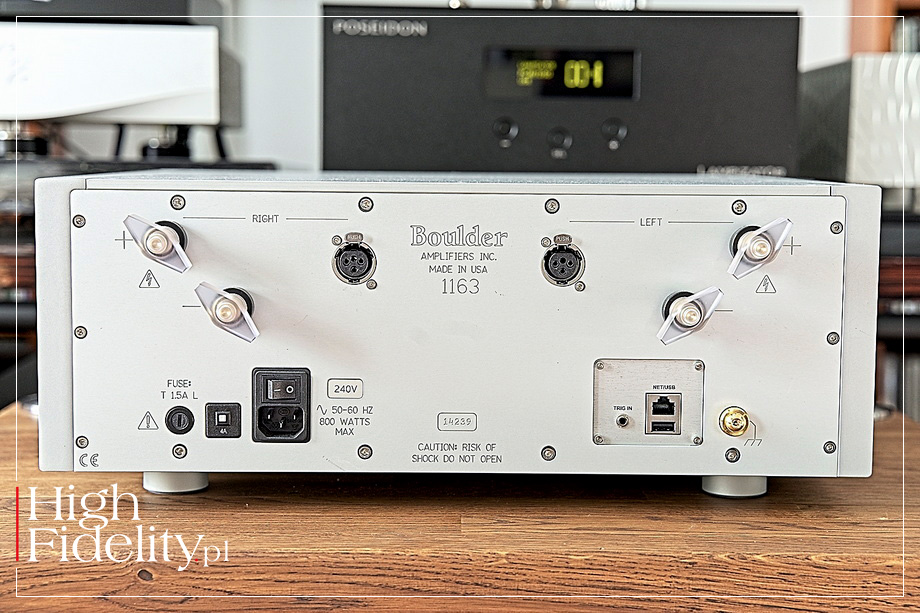
In the case of the Boulder 1163 (given the price of this unit, there’s really no other option), this stems largely from an even higher, purely high-end sound resolution. It contains even more of it– above all, those tiny little pieces of information, both purely musical and non-musical but still supporting, enhancing musical experience. Not broken down into details, not emphasized (except as required by the context of the music or performance), but freely, effortlessly, and loosely coming together into an exceptionally coherent, fluid, smooth (unless the music being played requires something else), and, as a result, very natural yet consistently neutral whole. A complete whole, that is, one that misses nothing. Obviously, certain elements of the performance can be presented even better– that much is hopefully clear, but the 1163 has no shortcomings, nothing that would detract from an excellent listening experience. Boulder’s new power amplifier is a great example of how high-end audio components combine naturalness with neutrality, thereby bringing the listener closer to the true sound of music (I’m referring primarily to acoustic music because when amplifiers, effects, etc., come into play, it’s actually difficult to speak of a natural sound, though one can still speak of a true one). There is not a trace of added warmth, nor any other form of coloration. The sound is pure and transparent, precise, well-organized, and provides good insight into the recording. But the natural (!) warmth of acoustic instruments and vocals is also superbly reproduced. All of this adds up to a free-flowing, relaxed sound that really “grabs you,” piques your interest, and draws you in, usually from the very first bars – even if you know the recording inside and out. One of the first albums I listened to that completely engaged and captivated me was Meditations by JON BATISTE and CORY WONG. The former is a wizard, above all, of jazz piano, and the latter, above all, of blues guitar. Together, they created something different and beautiful. The Boulder unit I tested gave me an excellent insight into the sound of Jon Batiste’s piano, allowing me to appreciate his extraordinary talent and technique, yet it delivered this wealth of information almost in passing. All of it was easily accessible, but located “in the background,” because in the foreground was the music, which captured one hundred percent of my attention, along with its reflective, cheerful, and highly positive atmosphere. The music consisted of sounds, with a clearly defined but not artificially hardened attack, and full sustain and decay. There was a soundstage where all of this unfolded – not overly large, but well-organized, with good instrument placement and imaging. Good, not perfect, because that’s how it was recorded on this album, and the American amplifier doesn’t bother with enhancing or embellishing the signal it receives. I could examine Cory’s guitar just as closely, and even the keyboards and drums, though these played only supporting roles on this record. Nevertheless, it was Jon’s acoustic piano – the richest in tone, at times even sweet – that made the greatest impression with its timbre, energy, ease, mass, and depth of sound so accurately conveyed by 1163. The Boulder 1163 may not stand out in terms of maximum output compared to other models from this manufacturer, but 150 W at 8 Ω – which is the impedance of the MACH 4s – and the AudioForms have a nominal impedance of 6 Ω– is really quite a lot. So, after that calm, lyrical album, I reached for, among other things, the soundtrack from Sinners. I should add that I chose the one composed by Ludwig Göransson, as there is a second, even more blues-oriented version featuring tracks by various artists, including the great Buddy Guy (who – spoiler alert for those who haven’t seen it! – makes a brief appearance in the film). Both are excellent, but I was more interested in the grand scale, power, momentum, and dynamics found primarily on the first release. It was fascinating to observe just how versatile the Boulder amplifier is because, on the one hand, it rendered Meditations so beautifully– which, in my opinion, is what sets it apart most from its predecessors– and on the other hand, it handled with ease Göransson’s powerful, unsettling music, full of dynamic shifts. Power, energy, dynamics, punch– these are all characteristics familiar from older models, but even with music demanding precisely these elements, the 1163 seemed to dig a bit deeper and bring more information to the surface– without pushing it forward– thus significantly enriching the presentation. As I mentioned, I am not talking about emphasizing details, about the analytical approach as such, but rather about the same attention to everything happening in the foreground as well as in the background, to direct and reflected sounds, to soloists and accompanying instruments, as well as to the entire acoustic environment of the performers. It’s about showcasing a tight, fast, powerful attack, but also a sufficiently long, full sustain and decay of every sound, as well as a faithful reproduction of its timbre and texture. About a flawless, precise rendering of dynamic contrasts – both on a macro scale and on a micro scale, where (in good recordings) so much is happening – as well as the timbre and energy level of each instrument (or rather, individual plucks of strings, strikes on keys, drum beats, bow strokes, and so on). 1110 • While still listening to the same album, I replaced Circle Lab’s with Boulder’s 1110 preamplifier. This wasn’t the first time I used it in my setup, but my first observation this time was still somewhat surprising: the first thing that I noticed was that the decays got even longer. 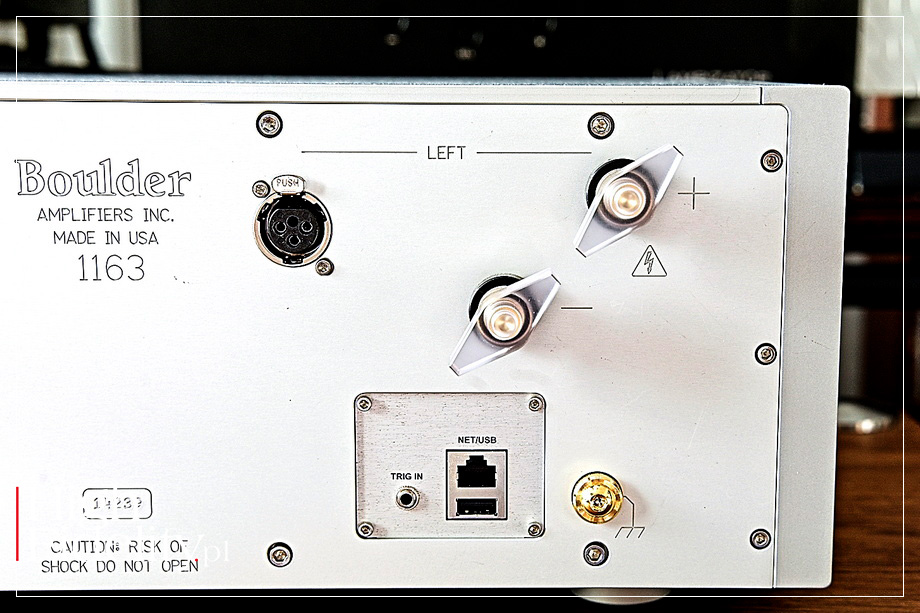
In this setup, the lowest bass also gained a bit more weight, which meant that the lowest sounds – especially electronic ones – were even more deeply anchored, and as a result, I felt them more strongly “in my bones.” Subsequent listening sessions with orchestral recordings confirmed these observations, further highlighting the ease with which the speakers, driven by the Boulder, reproduced even the most complex and densely layered pieces performed by large symphony orchestras. The longer I listened to the new 1163 amplifier, the stronger my conviction grew that the device also reproduced vocals even better – or perhaps more authentically– than its predecessors. For instance, while listening to Brothers in Arms – though not in the original version, but rather sung by the vocal group CLUB FOR FIVE– it felt more like my best experiences with tube amplifiers than with solid-state ones. The former (the best SETs, to be precise) are even better at rendering vocals, offering an even more natural and tangible sound, but the 1163 comes closer to it than Mr. Nelson’s older designs. Since we are particularly sensitive to the natural timbre and pitch of the human voice, this is an extremely important feature, at least for those who are passionate about listening to good vocals. Among the high-performance transistors I am familiar with, the 1163 will be one of the best choices for them. As a result, with the tested power amp in the system, listening to your favorite singers can easily overshadow tracks without them, at least at the beginning of your adventure with this amplifier. All the more so because the musical genre doesn’t really matter to it. The aforementioned vocal group performing well-known hits (from my youth :-)) sounded excellent, but the original with Knopfler, or the performances of other phenomenal rock vocalists– Steven Tyler (AEROSMITH), Chris Cornell (SOUNDGARDEN), or Brian Johnson (AC/DC)– and that’s a completely different style of singing, sounded just as great. The amplifier perfectly captured Johnson’s “hoarseness” and that incredible energy (by the way, I recommend that AC/DC fans seek out recordings of this singer from before he joined the band, when he sang completely differently). Boulder delivered Tyler’s characteristic, brilliant “screaming” as cleanly and convincingly as the recording allowed, leaving me, yet again, in disbelief that anyone could sing so well while controlling every note perfectly. Cornell’s voice, the lowest in the mix, was saturated with emotion, delicate and powerful at the same time. And all of this, after all, happened every time against the backdrop of a rock band “blasting away” with heavy guitars, bass, and drums. The amplifier kept the tempo and rhythm perfectly, playing rock with verve and energy but effortlessly, without tension or nervousness– everything, even on albums like these, seemed to be under complete control. But then again, also ANNA MARIA JOPEK’s concert performance, and later PATRICIA BARBER’s as well, captivated me– not for the first time, and surely not the last– with their beautiful voices. Sibilants, yes, were clearly audible, but not irritating. Vocal mannerisms– clear as day, yet perfectly integrated into the whole, defining the uniqueness of each artist – were features that, along with timbre and the ability to express and convey authentic emotions to the audience, stood out. Since I had listened to both ladies on live recordings, despite the artists’ undeniable magic, I also had the opportunity to pay attention to other elements characteristic of such performances. The presentation wasn’t quite as tangible and three-dimensional as with the best SET amplifiers, but that doesn’t change the fact that it was excellent and convincing, which was further emphasized by the faithfully reproduced, equally natural and engaging audience reactions, the very well-rendered hall acoustics, and the convincing imaging of large, (almost) tangible phantom images. As you probably know, I’m a huge fan of live recordings because I can’t attend such events as often as I’d like. In other words, I love live music, and I particularly value equipment that can capture the atmosphere and character of such performances. The Boulder 1163 hereby joins my personal not-too-long list of favorites, even though most of the items on that list are tube-based. ▒ Summary WHAT IS BOULDER LIKE is for anyone to see. 1163 belongs to the high-end segment without a doubt, and its appearance and build quality set the standard for this class of components, even though the American manufacturer’s lineup includes two even higher-end series. And although Jeff Nelson stated at a meeting a few years ago at Soundclub that one should ask others about the sound of his devices because he cares “only” about ensuring they are properly designed and built, the tested power amplifier, as it seems to me (see what I stated at the beginning), while it is as well designed and built, it does sound a bit different from its predecessors. It’s not that it offers a completely different sound, but rather that it’s more complete and therefore even better. This does not diminish the value of its predecessors but rather confirms the American brand’s development and its relentless pursuit of perfection. The 1163 is not a revolution compared to older models, but rather an evolution. For it is still an amplifier that perfectly controls the speakers, sounds transparent, pure, and energetic, and the dynamics of its presentation are exemplary. This device plays even large-scale symphonies or heavy metal madness with ease and proper momentum, while at the same time it impresses with its sophistication when it comes to perfectly recorded (and performed, of course) jazz or vocals. I thought that previous models already perfectly combined the traits of natural and neutral presentation, but the 1163 proves that it can be done even better. I can’t find any better way to describe its sound as highly musical and amazingly coherent. 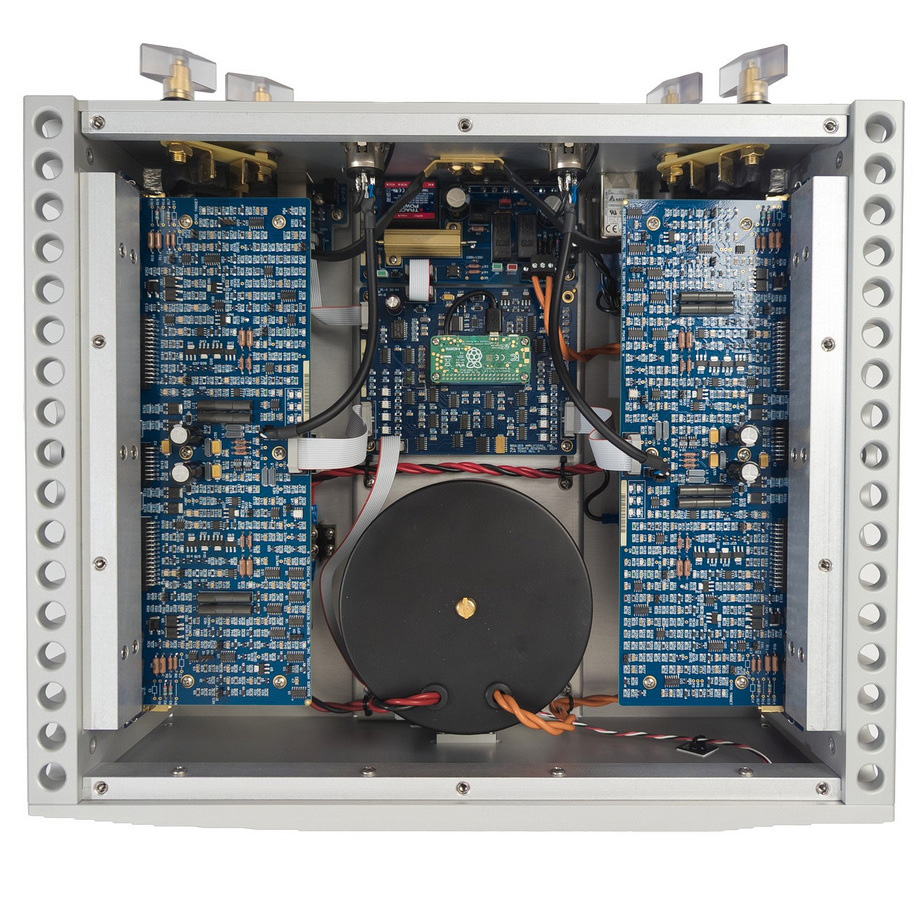
The designers have also managed to increase the excellent resolution upon which the sound and refinement of this device are based. This results in an audibly denser, and consequently a darker (because fuller, more saturated) sound; yet, there is still not a hint of warmth or other coloration in it. What’s more, the Boulder offers insight into recordings at a level unattainable for many competitors from other brands; yet it is not a ruthless, analytical beast that will eliminate anything below the “audiophile” standard from your music library. Well, everyone can see and hear what the Boulder is like– excellent! This is an amplifier built to last, for very expensive systems designed for audiophiles and music lovers alike. If the price doesn’t scare you off, give it a try – it’s truly worth it! ‖ MD ▒ Technical specifications (according to the manufacturer; measurements performed for the 120 V version)
Nominal continuous output: 150 W/ 8-4 -2 Ω 
THIS TEST HAS BEEN DESIGNED ACCORDING TO THE GUIDELINES adopted by the Association of International Audiophile Publications, an international audio press association concerned with ethical and professional standards in our industry, of which HIGH FIDELITY is a founding member. More about the association and its constituent titles → HERE. |
 |
|
|
