


|
INTEGRATED AMPLIFIER HAIKU-AUDIO
Manufacturer: HAIKU-AUDIO |

 |
 |
 |
|
Review
text by MAREK DYBA |

|
No 259 December 1, 2025 |
⌈ HAIKU-AUDIO is a Polish company based in Krakow. It was founded in 2012 by WIKTOR KRZAK, a musician and audio enthusiast. It specializes in the design and manufacture of amplifiers and preamplifiers, including phono stages. Most of them are tube designs, but the company does not shy away from transistors. We are testing an integrated amplifier using the latter technology, the SOL 2 PRO. ⌋ THERE IS SOMETHING TO THE CLAIM that the older you get, the faster the years seem to fly by. I hadn't had any contact with Haiku Audio products for quite some time, but when I finally did, for a moment I felt as if they had only just started making fuss on the market. After I while I realized, that thirteen years have passed (apparently not unlucky number in their case at all)! My associations with the brand are quite obvious – each of their products is always well-sounding, well-made, proving that it is possible to manufacture and sell such products with (I assume) a decent profit for a reasonable price. 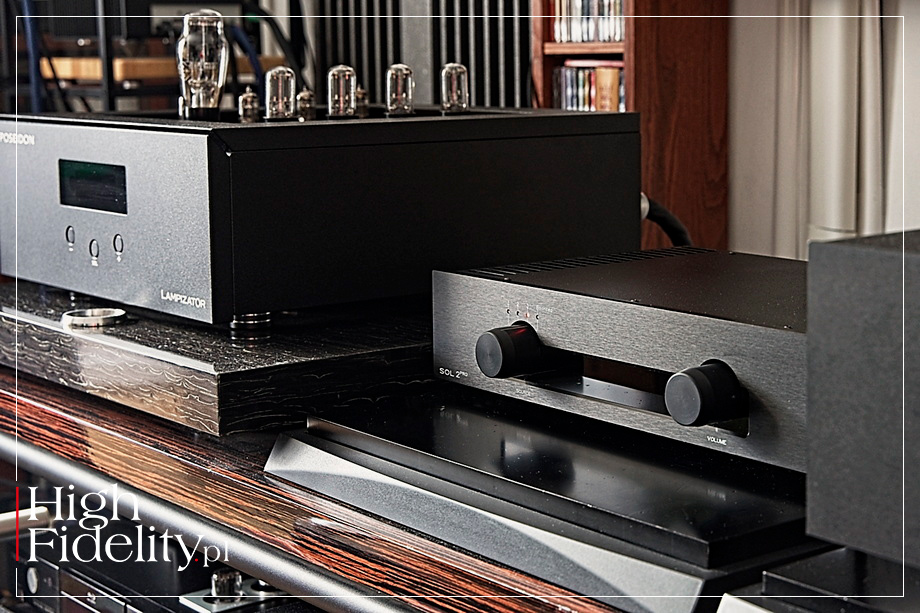
The latter assumption seems to be correct based on the fact that the company is still operating, unlike many others which, even after impressive debuts, disappeared into the depths of (not so distant) history. During those 13 years Haiku-Audio did not focus exclusively on “cheap” designs, as it did not shy away from those that cost a little more and, by definition, had to compete with the legends coming from well-known brands. I am talking about models featuring 300B or 211 triodes. In their case, no one looked at who made them and how much they sold for, but how well they sounded compared to their (mainly Japanese) competitors. And they “got the job done” as far as I am concerned, offering a great deal of unique experiences for a fraction of the price of their competitors. Ever since I first became acquainted with Haiku-Audio, I have always been surprised by how good sound they offered at such attractive prices (compared to the competition). And yet they managed to do it time and time again, although the term “managed” became inadequate after a while, because a series of successes suggests knowledge, experience, and the ability to use them, rather than chance (implied by that term). Is the Sol 2 Pro another such case? The price seems to suggest so, but only if it is accompanied by sufficiently good sound. We will try to take a closer look at it. But first... ▲ A few simple words… JAREK ŁUKASZEWICZ 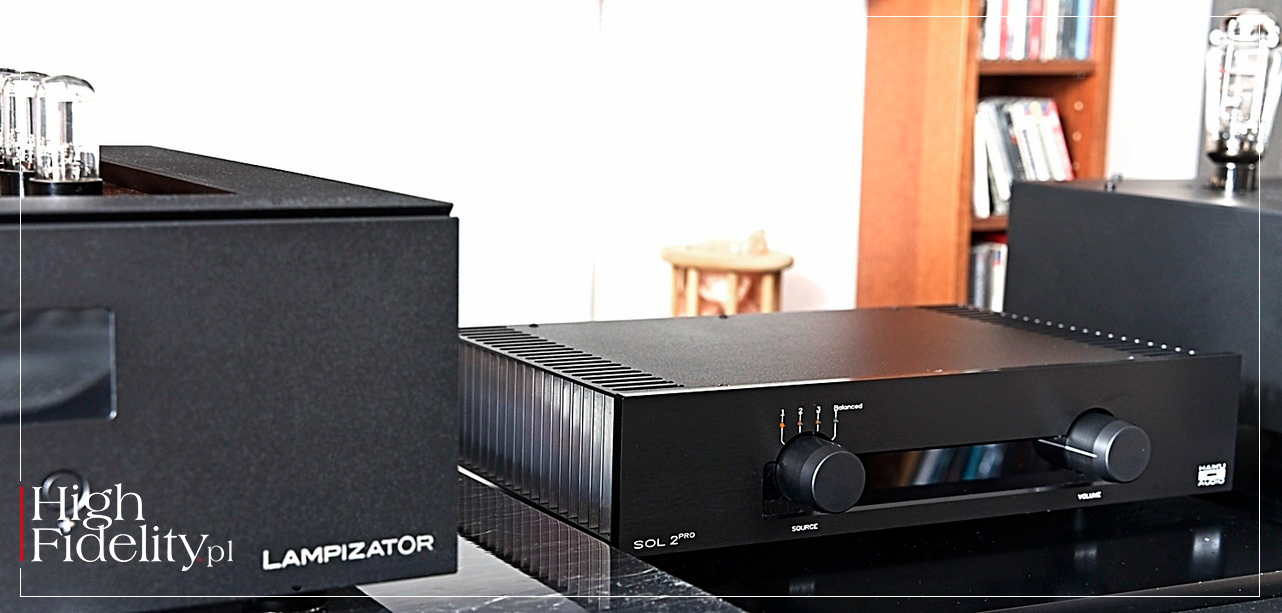
THE AMPLIFIER WAS DEVELOPED in response to a request from one of the recording studios we work with. The task was to create a solid-state amplifier that would offer the sonic characteristics typical of Haiku-Audio and would be a good partner for a wide range of speakers (which are used in their listening room). It also had to be accept balanced (XLR) connection. An additional task was to fit the amplifier into a low-profile housing. We completed the task, and soon after, several musician and music lover friends said they would like to have such an amplifier at home. So we adapted the design for mass production. The design is a continuation of the Sol line, which has been developed practically since the inception of Haiku. In all models, the circuit is based on an identical topology of three gain stages without feedback. In accordance with the original idea, the first two stages of the amplifier operate in Single Ended Class A, but the heart of the amplifier is the second stage, which operates using a single FET transistor with high bias current, which directly controls a complementary pair of bipolar output stage transistors. 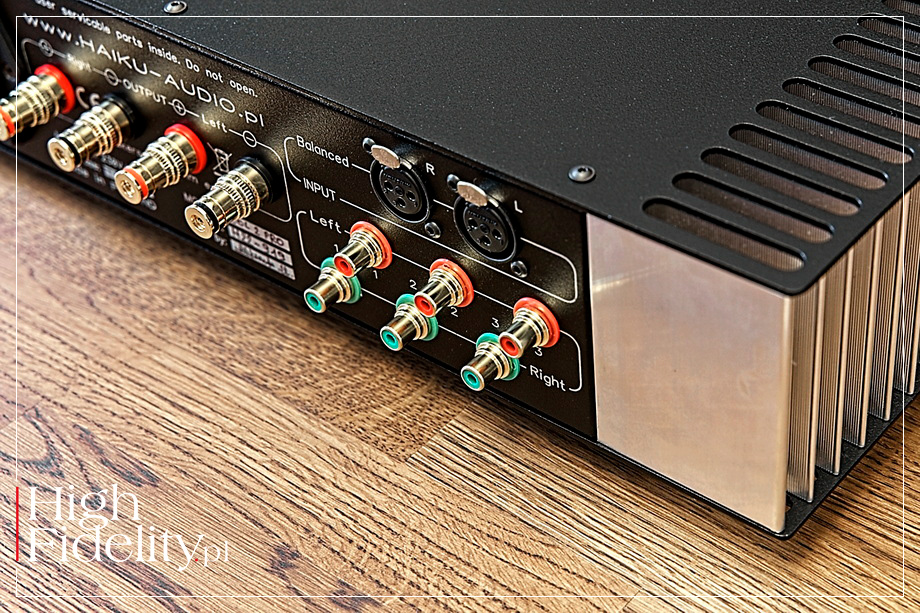
When working on this project, we based our design on the old, much-loved Sol II model. The Sol 2 Pro shares the same Toshiba output transistors with it, but we doubled their quantity, which allowed us to also double the output power (100 W/8 Ω and 180 W/4 Ω). The “Pro” in the name obviously refers to the amplifier's studio pedigree. The SoL 2 Pro is the first amplifier in the Haiku “home-user” range to feature a balanced XLR input. Following the example of classic recording studio equipment, an interstage transformer is responsible for balancing the signal, so there are no additional transistors in the signal path, let alone integrated circuits. As usual, all housing components, printed circuit boards, and power transformers were designed and manufactured in Poland. ALPS potentiometers and Neutrik sockets are mandatory additions. The amplifiers are hand-built, measured, listened to, and packaged in our workshops in Krakow and Kielce. » JŁ ▌ SOUND HOW WE LISTENED • Haiku-Audio Sol 2 Pro integrated amplifier was tested in my reference system, where it was compared to the Grandinote Shinai, which is also a solid-state, but much more expensive, Class A integrated amplifier. The primary source of the digital signal was my custom passive server running the latest version of Roon, equipped with a top-of-the-line JCAT XE Evo USB card with an external Ferrum Hypsos Signature power supply. The card is supported by JCAT's Master OCXO Clock Upgrade, which is also supported with an independent power supply in the form of Optimo Nano. 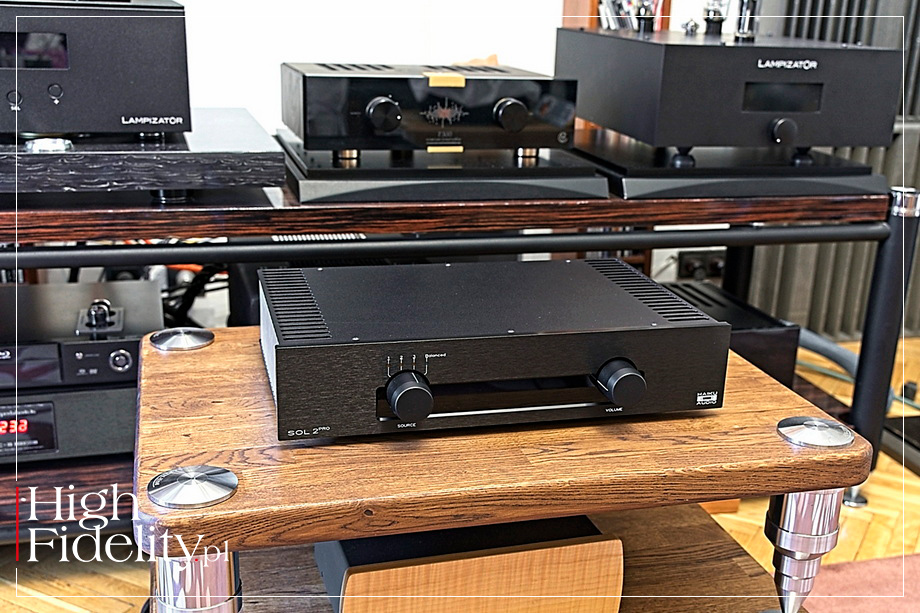
The signal was fed to the LampizatOr Poseidon D/A Converter via a top-of-the-line David Laboga Custom Audio Akoya USB cable and then to the amplifier via a Soyaton Benchmark unbalanced analog interconnect. From the Sol 2 Pro to the Grandinote Mach 4 speakers, the signal was sent using Soyaton Benchmark Mk 2 speaker cable. On the analog front, the main role was played by my excellent J.Sikora Standard Max turntable with two tonearms from the same manufacturer, the KV12 Max Zirconium Series and the KV9. The former was equipped with an Air Tight PC-3 cartridge, while the latter had a Le Son LS10 Mk II. The signal from both cartridges was amplified by a Grandinote Celio Mk IV phono preamplifier, interchangeably with a Grimm Audio PW1. The signal then traveled to the integrated amplifier via a Bastanis Imperial RCA interconnect. 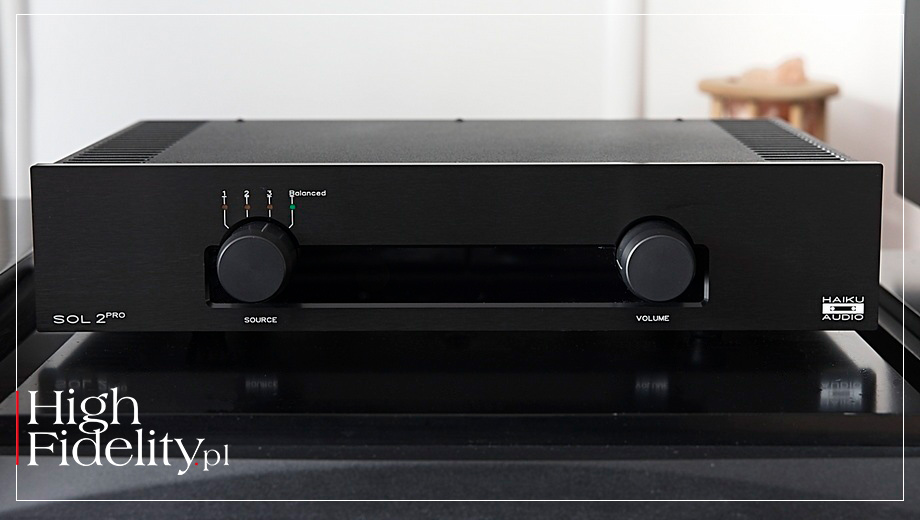
As an alternative pair of speakers in part of the test, I also used the latest and best (so far – with this designer, you never know if it's really the final version) version of Tomek Kursa's bookshelf speakers, the AudioForm M200. Finally, because (spoiler alert!) I really liked the amplifier, just for fun, I connected the excellent Ø Audio Frigg 02 to it. HAIKU-AUDIO SOL 2 PRO amplifier arrived a few days after the Warsaw AVS 2025. Like other shows in our industry, also the Warsaw one, which was excellent in terms of organization, attendance, socializing aspects, etc., was also a racetrack where exhibitors raced to present the most expensive system, amplifier, speakers, etc. And there is no denying that some of them sounded really good, even if the show’s conditions did not allow them to come even close to their optimum performance. But it is also a fact that many of them are simply beyond the financial reach of “normal” people. And so, after an exciting show featuring systems worth hundreds of thousands or even millions of zlotys (albeit after a few days reset), I ended up with an amplifier that costs less than 10 kPLN. Sure, it's still a considerable amount, but in the audiophile reality of the third decade of the 21st century, it's actually a bargain. So I plugged this not-too-big, not-too-heavy, specialized (because it only offers line inputs, no additional modules), simple integrated amplifier into my system, turned on the music and... not for the first time in my experience with Haiku-Audio, my jaw dropped. Is it really possible to make and sell a device that sounds this good for 10 kPLN in 2025?! Something's not right here, there must be some trick that deceives the ears, or rather the brain, right? There simply must be something about this design, because it sounds so good to me that I don't want to stop listening to it. Except that a day passed, then another, and the positive surprise and pleasure of listening to music did not fade. To be clear, it doesn't mean that it sounds better than my reference amplifiers (Shinai and Circle Labs set), but there is no performance gap that the price difference between them would suggest. Also, there is something special about Haiku even if I can’t yet specify what it is. So what is it? – A combination of features that make music from the Sol 2 Pro sound so good, so easy to listen to. It's lively, even spontaneous, but that might suggest a lack of control, which is absolutely not the case with the Sol 2 Pro. It is high-octane playing, meaning that it does not lack energy regardless of the type of music or volume level. Paired with the Mach 4, the tested amplifier produces deep, powerful, colorful, yet controlled and tight bass, resulting in flawless PRAT (pace, rhythm, and timing). 
And yet it is also open, free and—I rarely use this term, but it seems to fit perfectly here—joyful sound. The latter term means that it brings a smile to my face, putting me in a good mood. Whether it was KENICHI TSUNODA's big band or even the “dark” version of PETER GABRIEL's album i/o, I listened to each of them from start to finish with full attention and a smile on my face. This kind of playing reminded me time and again of the Bryston Mini A bookshelf speakers I tested, I think, 10 years ago. These speakers are also inexpensive and offer similar pleasure and fun when listening to music. Sol 2 Pro’s sound is slightly expansive. It is not a relaxed presentation of sound located behind the line connecting the speakers, but rather sound coming out towards the listener. It's not about “throwing it in listener’s face”, but rather bringing what's happening on stage closer and making the listener feel like they're part of the event. This does not mean shortening the depth of the stage, but rather bringing it as a whole closer to us. This inexpensive transistor amplifier continued to surprise me with how nicely it built successive layers of music on the stage and how nicely it placed large phantom images in them. |
In some recordings, especially those with a spacious soundstage, both natural and console-generated, the sounds seemed to come from places located many meters behind the speakers and beyond their spacing. The former was clearly audible on Michel Godard's album Trace Of Grace (Wojtek, Dirk, and Birgit tried to make me dislike one of these recordings on AVS, but they didn't quite succeed :-) ), recorded in an old abbey with reverberation, sounds, and reflections wandering along distant walls far behind the musicians. 
The latter sounded even more impressive with the Sol 2 Pro, for example on Pink Floyd's DSotM or The Wall, where the producers played with phase inversion to create very convincing spatial effects. Both Godard's album and a number of live recordings from small clubs showed that, while Sol 2 Pro cannot create such three-dimensional, tangible phantom images as good tube amplifiers, it does not matter much in the context of perceiving the intentions of the creators of these productions. Whether it was a concert by Oscar Peterson’s band, Ray Brown's trio, or Michał Salamon from the Jassmine club, each of these events was presented in a way that engaged the listener, making me feel more like a participant than a passive observer of each of these events. All the more so because not only the acoustics, but also the audience's reactions sounded simply put: real. I have said many times that if a given component can reproduce applause in a convincing way, then everything else usually sounds at least good. And the Haiku-Audio integrated amplifier reproduced applause, shouts, and everything else in a truly convincing manner. While listening to MANU KATCHE's concert (that I learned about at the AVS, which is another advantage of this event – I always discover at least a few excellent albums that I should know, but don't), I paid a little more attention to aspects that I had previously “ignored”. I put this term in quotation marks so that you don't take it literally. It is impossible to ignore them if they are presented poorly, because they spoil the naturalness of the sound and pleasure of listening, and from the very beginning I have emphasized the exceptional pleasure of listening that the tested amplifier gave me. Take dynamics, for example. Everyone will easily appreciate it on a macro scale, because the Sol 2 Pro delivers it eagerly and exceptionally well. On a micro scale, it may not be quite as good, but a well-recorded concert with lots of acoustic instruments showed that this inexpensive integrated amplifier can also display a lot of contrasts, not only dynamic but also tonal ones, playing out in the shadow of the big, impressive ones. It's not quite a high-end level, but a solid hi-fi, for sure. It allows you to savor the individual performances of the musicians and the sound of their instruments. And when it's such an energetic concert, so heavily based on tempo and rhythm, like the aforementioned Manu’s, the Polish amplifier performs well above the expectations of a device that costs only “10 kPLN.” But it's not like the Sol 2 Pro is only capable of blasting some highly energetic music, as I learned when listening to another discovery from the AVS, SEAN ROWE. Admittedly, to my ear, the music is more pop-oriented, but the vocals are great and the recording quality is good, so it's no wonder that it was used during one of the AVS presentations, and it also came in handy when I was listening to Haiku. It showed the more lyrical side of the tested integrated amplifier. The calm, melodic playing with leading vocals (supported by backing vocals) sounded more than pleasant, it was smooth, coherent and, this time, relaxing. Right after Sean, I cued in ANNE-SOPHIE MUTTER with her Bizet Carmen fantasies. And Sol 2 Pro surprised me once again. After all, classical music is one of the greatest challenges for home audio systems, and this inexpensive integrated amplifier caught my attention from the very first notes and kept me focused until the very last. Mutter's violin sounded sweet and melodious, but it could also scratch your ears. Accompanying her, the Vienna Philharmonic Orchestra under Levin played with panache and ease. To be honest, there was nothing to complain about in terms of the scale of the presentation and dynamics (on a macro scale, at least). In this respect, Haiku could be envied by many twice as expensive amplifiers, and although everything seemed effortless and relaxed, it was also kept firmly in check. The Polish integrated ensured clarity and surprising precision of presentation, but also its fluidity and naturalness, combining all the elements together into a great sounding whole. The choir opening of the 1812 Festival Overture conducted by Kunzel sounded just as impressive as the Cincinnati Philharmonic Orchestra when it took over from the choir. The dynamics of this recording are at times simply stunning, and to enhance the effect, I turned up the volume quite a bit beyond my “norm”. The Sol 2 Pro once again demonstrated how easily it drives and controls the speakers and how much performance it can squeeze out of them. After all, the Mach 4s don't extend as low as my Ubiq speakers, nor do they have a large woofer at the bottom pushing tons of air. And yet, at the right moments, they were able to deliver low, powerful sounds (drums and cannons) that I could feel deep in my bones. The M200 stand-mount speakers sounded similar, although the limitation at the very bottom was greater. 
All this contributes to the uniqueness of the tested amplifier. On the one hand, it has quite a lot of power and knows how to use it, in other words, it behaves like a thoroughbred solid-state amp. On the other hand, however, it is a modern transistor, one in which musicality, fluidity, and natural smoothness are equally important. And yes, today, which was difficult to predict fifteen or even ten years ago, most solid-state amplifiers perform in this manner. The thing is that their creators no longer focus solely on detail, precision, transparency, cold neutrality, power, and dynamics of sound, but combine them with fullness, smoothness, and fluidity, and that cold neutrality has been replaced by (actually warm, dense) naturalness. And although the Sol 2 Pro does not cost much, it, like amplifiers costing tens and hundreds of thousands PLN, offers this very character of sound. ▌ Summary OK, SOL 2 PRO IS NOT AS RESOLVING AS REFERENCE AMPLIFIERS (not to mention even more expensive ones). It's not as saturated, as dense, it doesn't differentiate recordings quite as well, and it doesn't quite match them in terms of dynamic and tonal contrasts, especially at the micro level. In short, it is not as sophisticated as with much more expensive amplifiers. It’s just that, first of all, it doesn't really matter when it comes to listening pleasure, and secondly, I'll say it again, the differences aren't as big as you might expect. To put it another way: apart from really good sound, the Sol 2 Pro offers excellent value for money! Achieving that with tubes at this price point wouldn’t probably be possible, as these require expensive transformers, chokes, etc. It would be very difficult to stay within such a budget and achieve a comparable sound quality. However, this integrated amplifier proves that you can do without tubes, and the sound is still natural and pleasant to the ear, the vocals sound real, as do the acoustic instruments, and the spatial aspects of the presentation are also good. And with all this, we also get a high energy, scale, momentum, and great PRAT. That combination of features will allow you to listen to a jazz trio, a rock band, and a symphony orchestra with equal engagement and pleasure. Sol, as the name seems to suggest, can brighten up even a gloomy autumn day for hours on end, whether you listen to it in the background while going about your daily activities or focus entirely on the music (which is really easy with Haiku), and on top of that, it will give you perhaps even double the enjoyment. I imagine that its owners will have a smile on their faces not only because of the sound, but also because they know they got it for less than 10 kPLN. It is really good and proudly Made in Poland! Well deserved ˻ RED FINGERPRINT˺! ▌ DESIGN SOL 2 PRO is a transistor-based integrated amplifier. Its dimensions and weight are not particularly impressive (450 x 350 x 100 mm and 12 kg, respectively), but its power certainly is, as it can deliver up to 105 W at 8 Ω and 180 W at 4 Ω. The manufacturer does not specify the exact distribution, but the first watts are delivered in class A, and the rest in AB. The device is housed in a rather modest-looking but well-made and finished black metal case supported by four feet. The front panel features two large knobs: an input selector and a volume control. They are accompanied by a single not too bright red power LED. The sides of the chassis are solid heat sinks that effectively dissipate excess heat. On the rear panel, next to the IEC power socket, there is a power switch. Next, you will find three pairs of gold-plated RCA sockets, and above them one pair of XLR sockets – all of which are line inputs. The set of sockets is complemented by solid, single pair of gold-plated speaker posts. An additional accessory is a neat remote control. As you may have read above, Sol 2 Pro is a continuation of the Sol line. Its design is based on an identical topology of three gain stages without feedback. The first two stages of the amplifier operate in Single Ended mode in class A, but the heart of the amplifier is the second stage, which features a single FET transistor with high bias current, which directly controls a complementary pair of bipolar output stage transistors. The same as in the Sol II model, also here Toshiba power transistors were used. However, the number of them was doubled, and thus so did the output power. 
Sol 2 Pro is Haiku Audio's first amplifier designed for home users equipped with a balanced XLR input. A balanced transformer is responsible for balancing the signal, rather than transistors or integrated circuits. As the manufacturer emphasizes, continuing the brand's tradition, all components of the housing, printed circuit boards, and power transformer were designed and manufactured in Poland. ● ▌ Technical specifications (according to the manufacturer):
Integrated solid-state amplifier with remote control 
THIS TEST HAS BEEN DESIGNED ACCORDING TO THE GUIDELINES adopted by the Association of International Audiophile Publications, an international audio press association concerned with ethical and professional standards in our industry, of which HIGH FIDELITY is a founding member. More about the association and its constituent titles → HERE. |
 |
|
|
